I think that as an Artist looking for inspiration, looking to different approaches from different movements and era’s is a good for expanding my knowledge as an Artist. So for this Artist Research I wanted to look at a variety of different styles from different era’s to really open up to inspiration and what I can produce in terms of landscapes, something really out of my comfort zone.
Albrecht Durer- Late 1400s to early 1500s
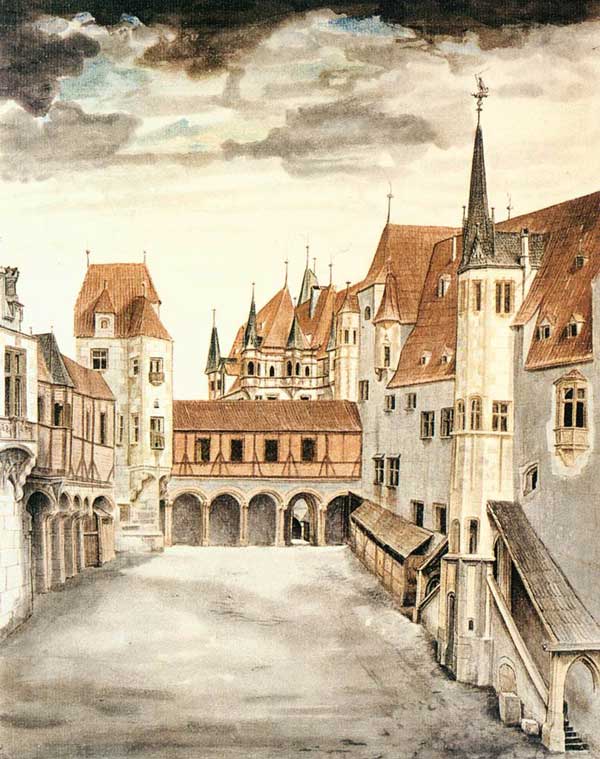
This piece fits into a traditional aesthetic and approach, looking to be an accurate depiction of the environment. The use of water colour allows for layers of detail built up on the architecture and a soft approach to the sky and floor, where there are less definitive details, allowing for the focus to remain on the structures. The focal point for the viewer, is clear and guided by the lack of detail and medium on the areas surrounding the architecture. The built up darkness towards the top and bottom of the paper helps create a subtle vignette, again, guiding the viewers attention inwards towards the structure. I should take away from this piece the Artists approach to the edge of the piece, and how it can affect the viewers gaze and the composition. I would like to be smart and careful in my approaches to landscape to guide my viewers gaze towards a clear focal point, whether it be a structure in the composition or a simple tree in a field. I need to be wary of my space, how I use it and how it can affect the composition entirely.
The perspective also works well to draw in the gaze with the lines all directed towards the center. When looking at structures at a close distance like this, I should consider how to effectively use perspective to make a visually pleasing composition that draws to the center or a clear focal point, that could be part of the structure, a street or a door. The colour palette, although ti works well together (quite harmonious colours) I find it quite drab and uninteresting. It doesn’t really say much about the environment other than there being a lot of brown tones present. It’s not experimentative or eye catching and it makes the piece quite bland compared to others I looked at. I should consider how my choice of colour could work against a piece, whether I could exaggerate certain colours for a more aesthetically pleasing look to a piece.
Claude Lorrain- 1600s (Baroque era)
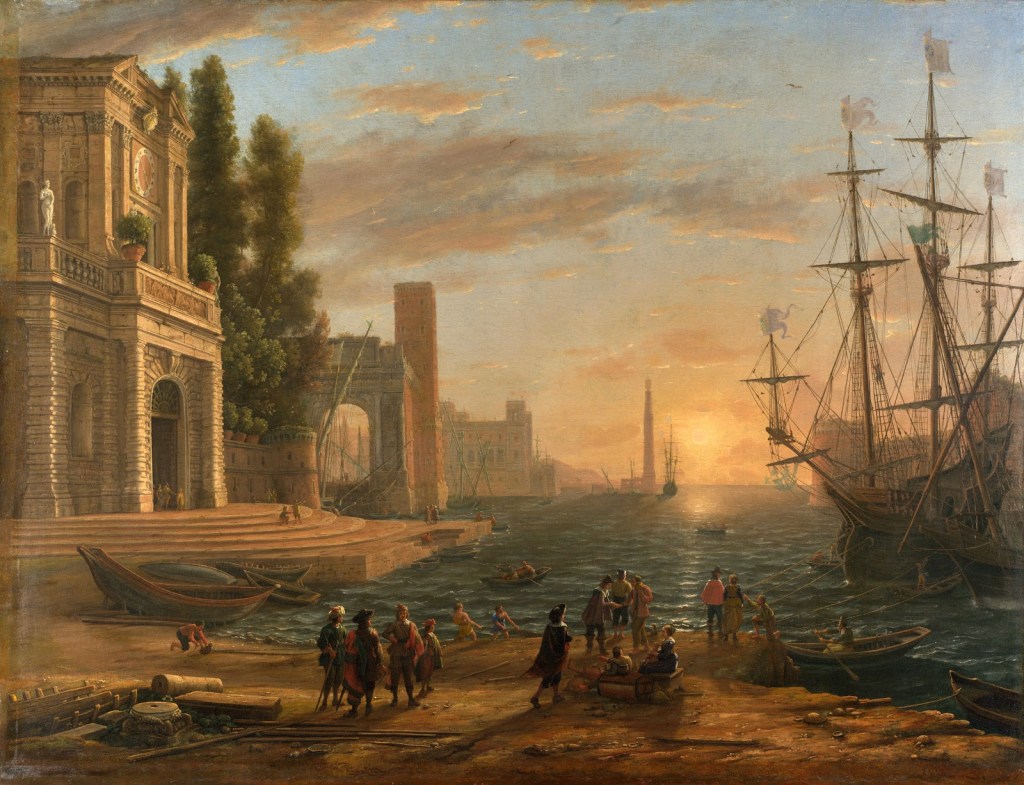
Lorrain’s work is really effective at creating an immersive landscape with a heavy focus on lighting and how the natural light casts and creates shadows across a landscape. I found myself obsessed with his paintings, all of which keep a focus on the sun whether it is sunrise or sunset, and how that effects the lighting of the environment. This piece was filled with beautiful warm colours and accurately capture the variety of colours the warm sunshine creates. I love the long shadows and how it creates quite a peaceful and hopeful image, despite the busy people working hard in the scene. the long shadows of the distant ship and tower cast across the ocean towards the viewer helps draw out the gaze from the foreground to the background. The use of perspective is stunning, drawing the viewers gaze slowly, but inevitably to the vanishing point of the sun.
I never really thought about lighting a landscape and how trans-formative it can really be. It’s made think more about shadows and times of day, how it could help me to create an aesthetically interesting piece or help push a narrative within my work as it Lorrain does so well in his paintings. I want to really think about my lighting when it comes to creating my future landscapes and the time of day, and how that can affect the outcome. How it might be worth it to wait for an evening with a strong prominent sunset in order to capture more stunning shadows being cast in an effective way but also how the lighting can affect the perspective of a piece as well. If I look at the shadows being cast, can I work with them to emphasise a perspective as Lorrain does so effectively here?
L.S Lowry -early to mid 20th century
Lowry has a distinctive style, which I love on him, but I’m not sure I could use for my work. Structures and landscapes are simplified into basic shapes with a gritty and moody colour palette, which works well to depict the industrialisation of the era he grew up in and worked in.
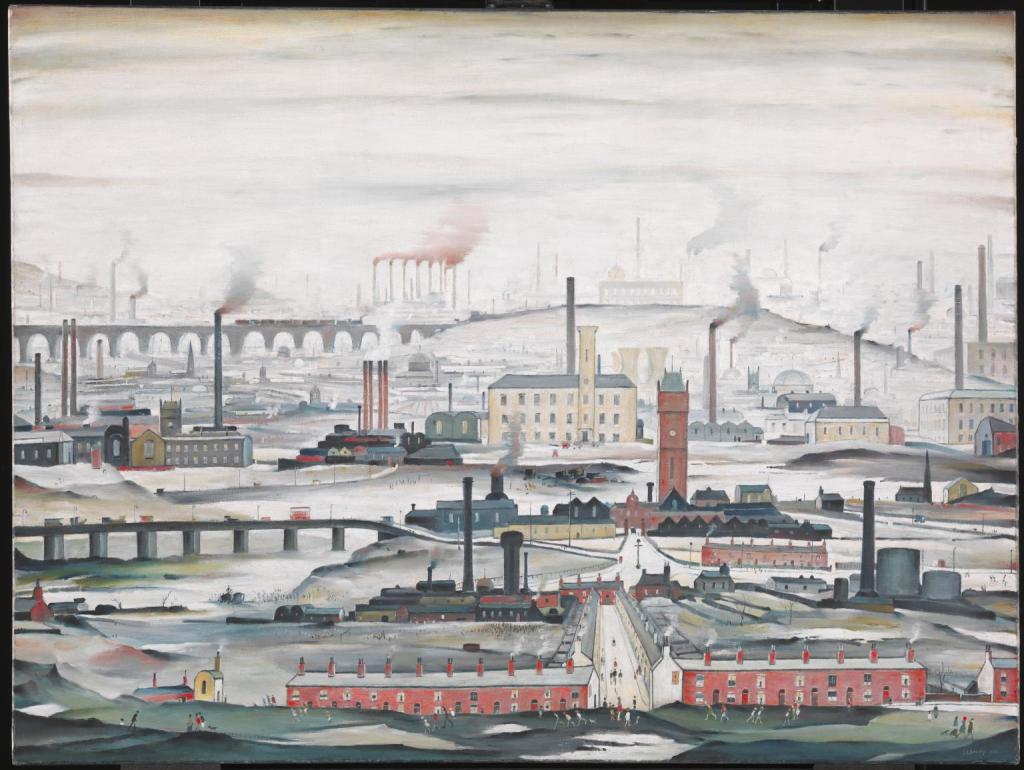
Lowry, L.. (1955). Industrial Landscape. [Oil] Available at: https://www.tate.org.uk/art/artists/l-s-lowry-1533 [Accessed 10 Aug. 2020].
I love how he depicts the buildings in bold, blocked in colours and contrasts this with a loose, more blended approach to natural landscapes such as the grass banks, water and smoke. His use of colour also works very effectively to bring about a bleak, depressing atmosphere filled with pollution. His use of colour not being bright but quite sickly in the greens, which he uses in the natural landscape, help push forward the depiction of a polluted world. His composition feels very flat, but filled with layers as the surroundings slowly blend out into the fog, and the landscape does go quite far back. his 2D approach to the landscape with basic shapes works well to create a stylised landscape more focused on creating an atmosphere which shows the horrible effects of industrialisation on the early modern landscapes of the 1900s.
When it comes to incorporating colour into my natural landscapes, I could look at how I use colour to depict the landscape in its current modern environment, I could perhaps focus on pollution and the ‘not-so-pretty’ aspects of the a town landscape. I’m not sure if I would like to simplify my depiction of landscape as much as Lowry does here, I don’t think that is necessarily my style as an artist, but it does work for Lowry in making a complicated landscape easy to take in.
George Shaw- Late 20th century to present
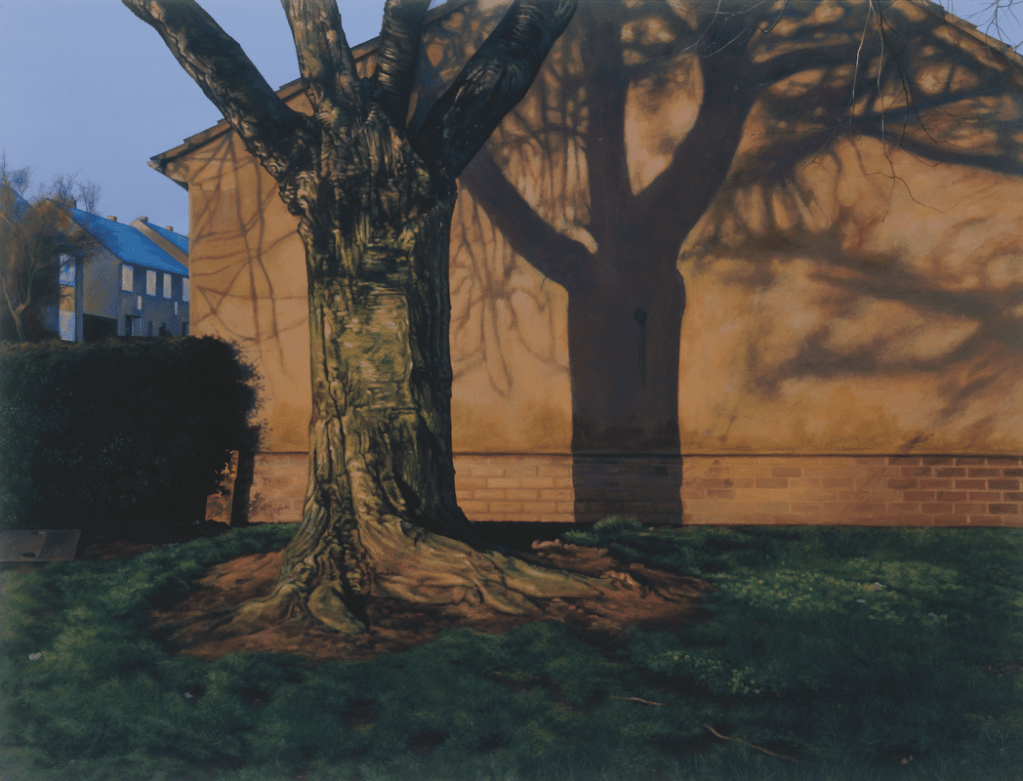
I really love the look of Shaw’s paintings, how from a bit of a distance they hold a resemblance to an old, poor quality colour photograph. I love his focus on drab, council housing and architecture, and how his compositions have a clear central focus. In this painting, the central focus is the shadow of the tree, which falls in the center of the page. His preference for lighting falls between bright sunrise or a drab cloudy day, this painting falls into the warm sunrise category. I liked this piece due to the use of warmer colours and the focus of the tree, and its shadow. I like how we are drawn to the tree, its warm tones don’t do too much to separate it from the warm colour of the house walls, but the cool shadows help the tree to stand out and forward. The contrast of the warm colours created by the suns rays and the cool blue tones of the shadows work well to depict a late British Autumn.
With Shaw’s heavy focus on British living estates its easy to get carried away with symbolism in this piece, whether it was purposeful or not. For example, the paint drip present in the shadow could represent a gun wound, the similarities are there. With the housing behind the tree the ‘gunshot’ could represent the death of the natural landscape that used to be present before the housing estate was built becoming the more prominent and recognisable landscape of Britain. That could be reaching, but the symbolism is there for the viewer to decide. I love the focus on the common housing present at the time of the painting and how Shaw has created beautiful paintings and imagery that showcase the common environment for the lower and middle class people. I love the focus on landscapes that surround us, instead of looking for a landscape elsewhere that could be more visually pleasing, he focuses on what the average person will be surrounded with day to day.
For my landscapes, when looking for inspiration, as well as looking for something visually pleasing, I could also challenge myself to find interesting and stunning compositions around me, where I live, my experience with landscapes that surround me in day to day life. Finding beauty and romanticising the drab housing estates that I experience daily.
Moving forward
My research has given me a lot to consider when it comes to approaching my landscapes for Part 3. I am most touched by George Shaw’s and Claude Lorrain’s approaches to landscape. Taking into consideration lighting and perspective in order to create interesting pieces as well as looking at romanticising my current surroundings as well as looking for scenic and beautiful places. I have a lot to consider and experiment with when it comes to my next few exercises and how I want to develop my practice and my approach to creating a landscape.
 Simona Hopewell : Drawing 1