Van Gogh
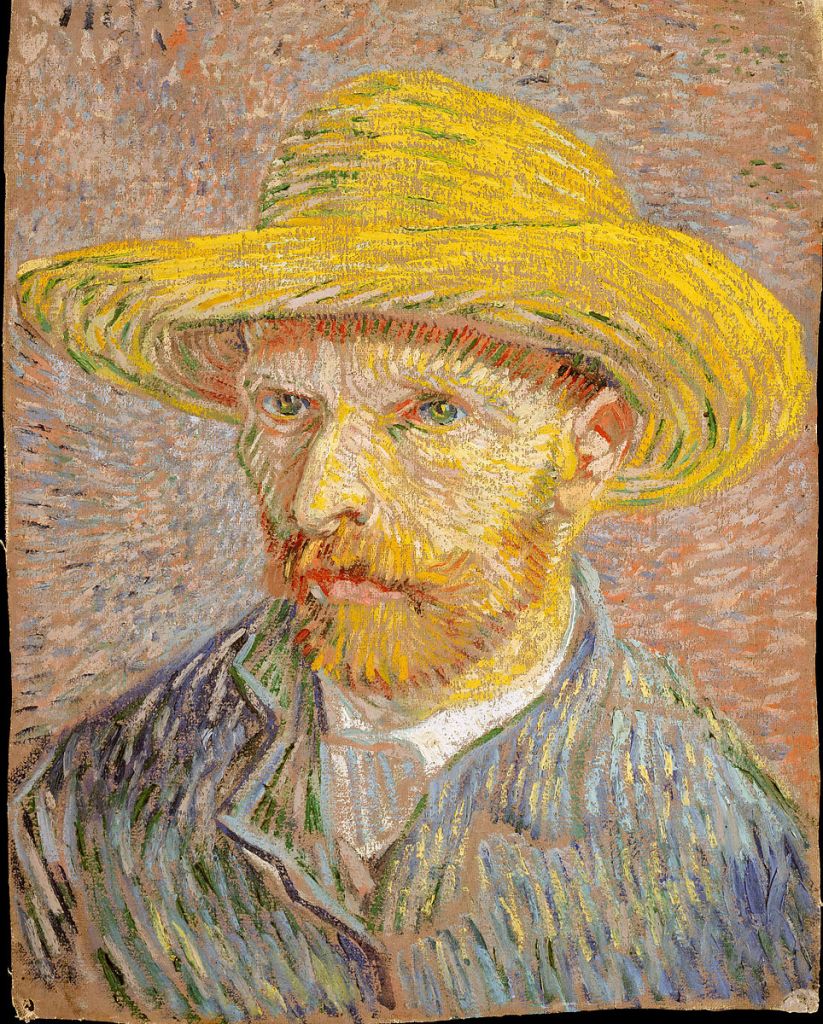
This painting is beautifully done with the use of line, the lines used in each part of the painting flow in their own direction and are moving with one another and against lines from other areas of the portrait. His colour choice is bright but not too much, and contrast nicely. Your gaze is drawn immediately to the bright yellow of the hat and move down to his face and then to his blue coat. The impressionist strokes work so well and could be a style I could use with my oil pastels on toned paper. The use of tone is soft, not too harsh at all, and works to create a somewhat delicate looking portrait. The pose is simple but the eyes are very telling, to me they show a lot of hurt and thought. Van Gogh sat for himself the most of the time and ‘Became his own best sitter’ [1] From the context of his self portraits, there is often a sense of loneliness within the work. I should look at the context of my sitters and drawing myself to add more depth or themes within my drawings.
Rembrandt
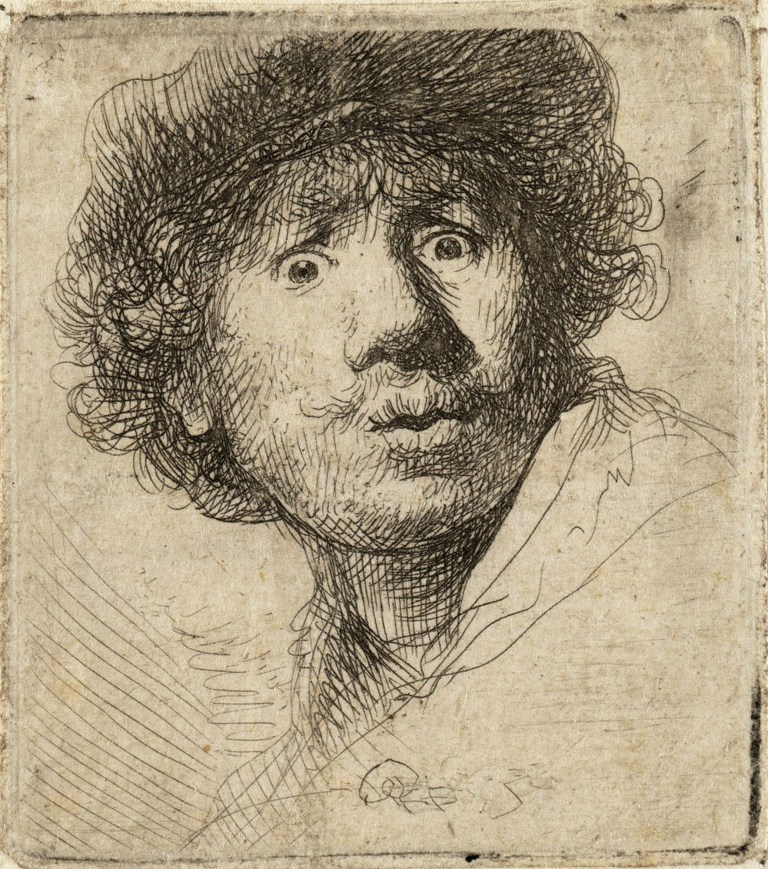
This piece is in an entirely different style to Van Gogh, using crosshatching in order to create harsh, dramatic tone across the face. This is a style I could look at when producing portraits that look a lot at the use of line, which could be done with a fine liner or ink. The pose is an interesting one, as most self portraits from this time period would tend to be serious, Rembrandt looks as if he is posing and making a funny face. It looks a bit fearful, like he has been spooked, but stands out as an iconic self portrait throughout art history. This drawing is actually an “example of a tronie; an unconventional style of portrait in which people were depicted with exaggerated facial expressions, and often in costume.” [2] . These were done at the time to be humorous, but Rembrandt also made a habit of using himself as his subject as this helped him become a recognisable figure within the artworld at the time as a lot of his work contained self portraits. So self portraiture to him was a form of self advertising.
Tracey Emin
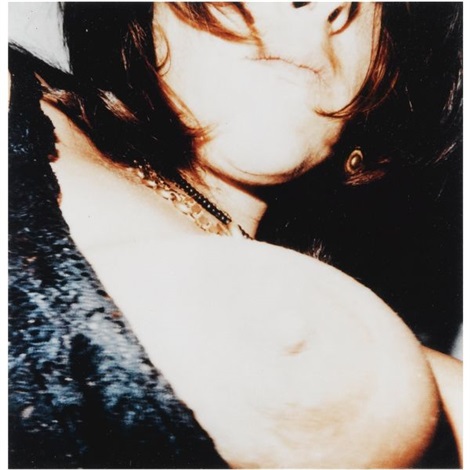
This self portrait is probably the most contemporary one I will look at and was done as a photo. There is a lot of tone in this piece as the image is over-exposed, most likely from the camera flash, create lots of bright areas and very dark areas. The pose is quite different as it only has a focus on the bottom half of her face and her exposed breast. Showing a lot of her self but not so much her physical identity. This fits within the context of her other work, all looking at her identity and experiences without necessarily looking at her face, for example her piece looking at her messy bed. I think tis a unique and modern approach that looks at how technology is used in our present times to express ourselves and out identity through selfies and photographs. A theme I could look at for perhaps my personal project and the view of myself.
This piece fits into that ideal male gaze of wanting a woman sexually but not intellectually, she gives the male viewer a look at her breasts but not her face.
Lucien Freud
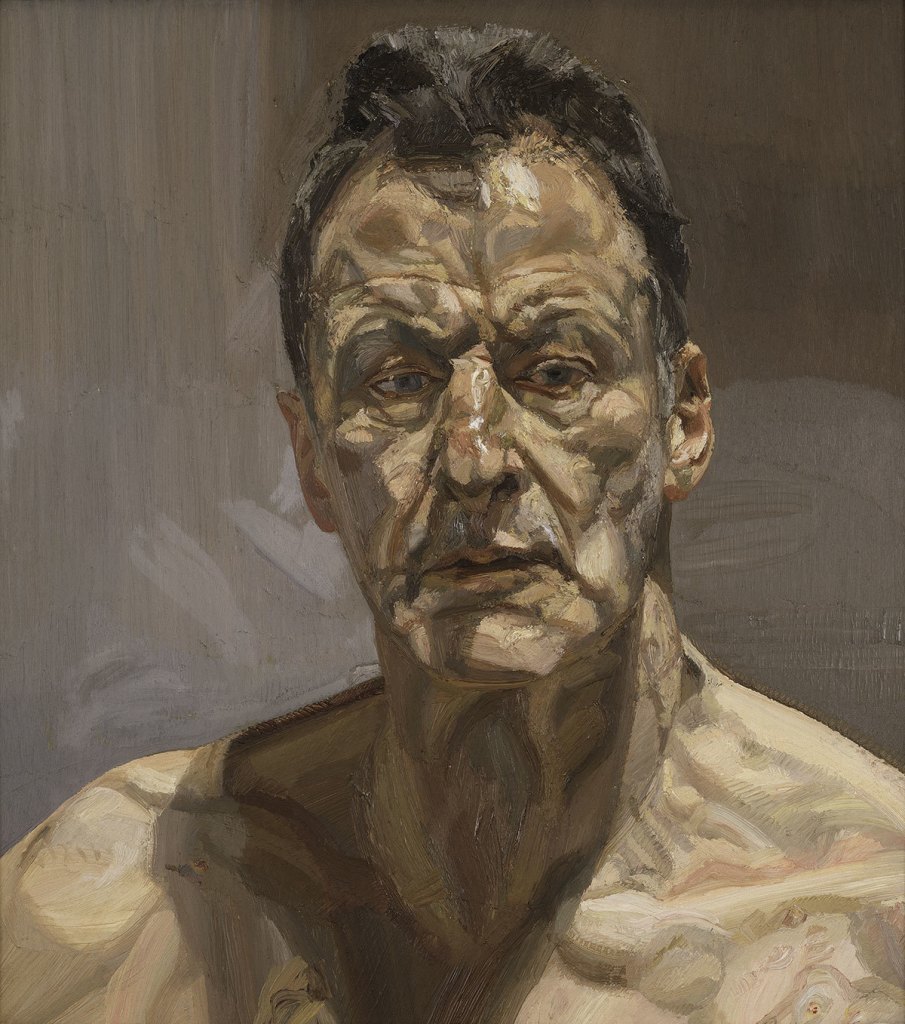
This piece by Lucien Freud is stunning. I love his technique with blocked in shades of skin tone that make a sea of perfectly captured skin tone. The lighting composition works well as he is lit from above casting interesting shadows down his face and body. The pose is very nice as well, as Freud looks deep in thought and contemplation. There is something very peaceful about this piece and I am in love with his technique. It is something I could hopefully emulate with my current drawing technique of layering oil pastels over water colour. Again, for one of my final assessment pieces, I could look at pose and the positioning of lighting in order to create an interesting and moving piece.
References
Image 1- Van Gogh – Van Gogh, V. (1887). Self-Portrait with a Straw Hat (obverse: The Potato Peeler). [Oil on canvas] Available at: https://www.metmuseum.org/art/collection/search/436532 [Accessed 9 Jan. 2021].
Quote [1] – (Metmuseum.org. (2020). [online] Available at: https://www.metmuseum.org/art/collection/search/436532.)
Image 2 – Rembrandt – Rembrandt (1630). Self-portrait with beret, wide-eyed. [Etching on paper] Available at: https://www.myddoa.com/self-portrait-with-beret-wide-eyed-rembrandt-van-rijn/ [Accessed 9 Jan. 2021].
Quote [2] – Daily Dose of Art. (2018). “Self-portrait with beret, wide-eyed” by Rembrandt van Rijn. [online] Available at: https://www.myddoa.com/self-portrait-with-beret-wide-eyed-rembrandt-van-rijn/ [Accessed 9 Jan. 2021].
Image 3 – Tracey Emin – Emin, T. (2001). Self portrait. [C-print] Available at: http://www.artnet.com/artists/tracey-emin/self-portrait-NlxYBnHyYFYXgg_k5o2SVw2 [Accessed 9 Jan. 2021].
Image 4 – Lucien Freud – Freud, L. (1985). Reflection. [Oil on canvas] Available at: https://www.royalacademy.org.uk/exhibition/lucian-freud-self-portraits [Accessed 9 Jan. 2021].
 Simona Hopewell : Drawing 1