What I really want to do with capturing the body is to depict a body that feels real but also is compositionally interesting. Looking into foreshortening I was able to rethink what makes an interesting composition and explore angles that add interest and style to the approach of drawing the body.
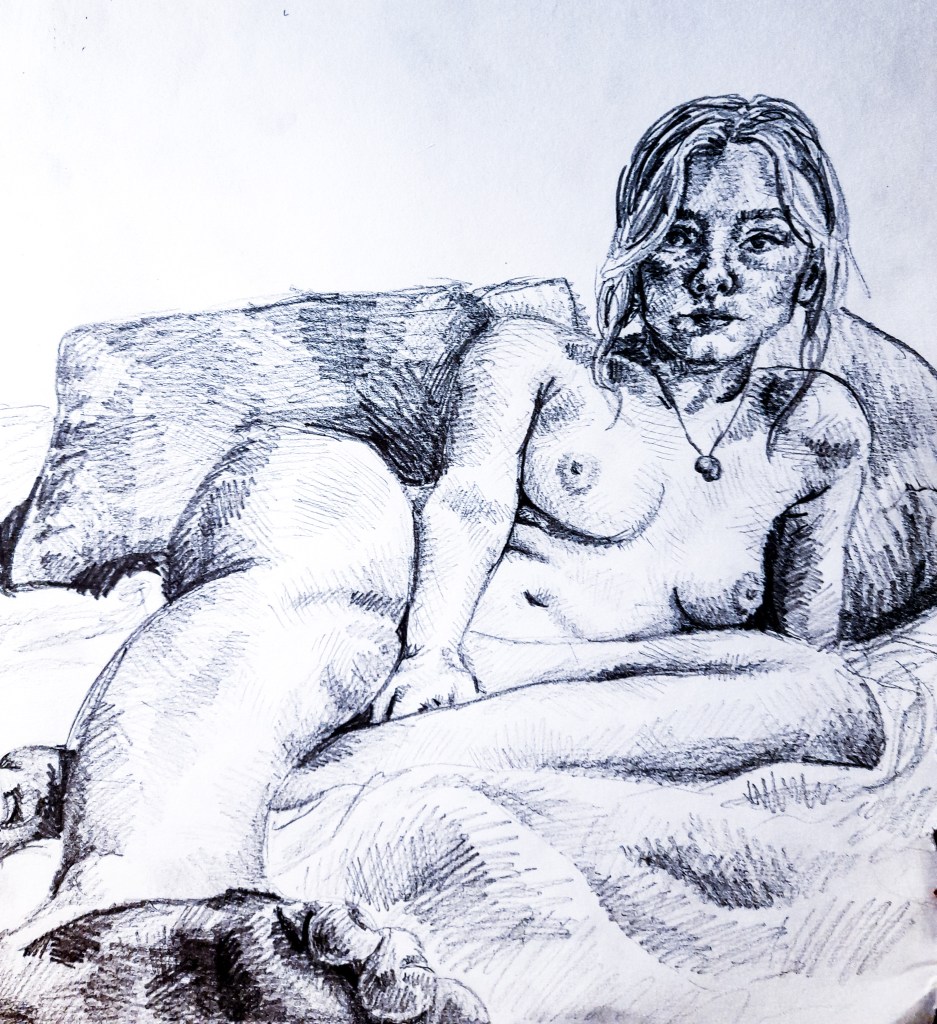
Pencil on A4 paper.
For my first look at trying a foreshortened composition I looked at myself in the mirror laying on my bed. I did it naked in order to really look at the shapes of the female body, since I haven’t been able to get a female model. The angle makes the drawing quite dramatic as the proportions have been changed to a skewered perspective. It adds a line of focus, drawing the viewers gaze in from the enlarged foot, to the chest.
The composition serves a purpose of creating a line from the foot to the face directing the viewer.
John William Waterhouse
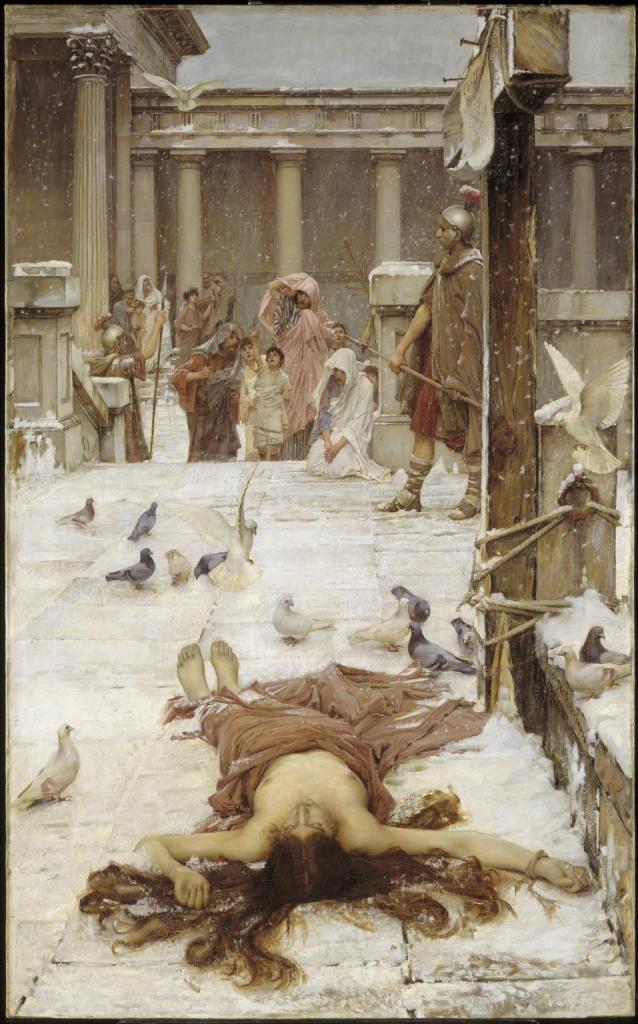
Waterhouse, J.W. (1885). Saint Eulalia. [Oil on canvas] Available at: https://www.tate.org.uk/art/art-terms/f/foreshortening [Accessed 2 Dec. 2020].
In this piece by John William Waterhouse, the foreshortening angle begins at her head rather than the feet, the line of her body is unique, twisting to the side. As quoted on the Tate site foreshortening can ‘ produce an illusion of projection or extension in space‘ [1] which the artist does do. The viewers gaze is drawn to the the woman, lying on the floor, the gaze follows the line of her body and is shown where to look next, her feet pointing to the rest of the unfolding story in the scene. Her body composition serves a purpose of directing the viewer where to look next, something I should really consider with the poses I depict. Can I show more with my model, and how can I use their body best to create a narrative, or guide the viewer. The painting is beautifully executed and the colour palette is simple and brown but works well to tell a grim narrative.
Otto Dix
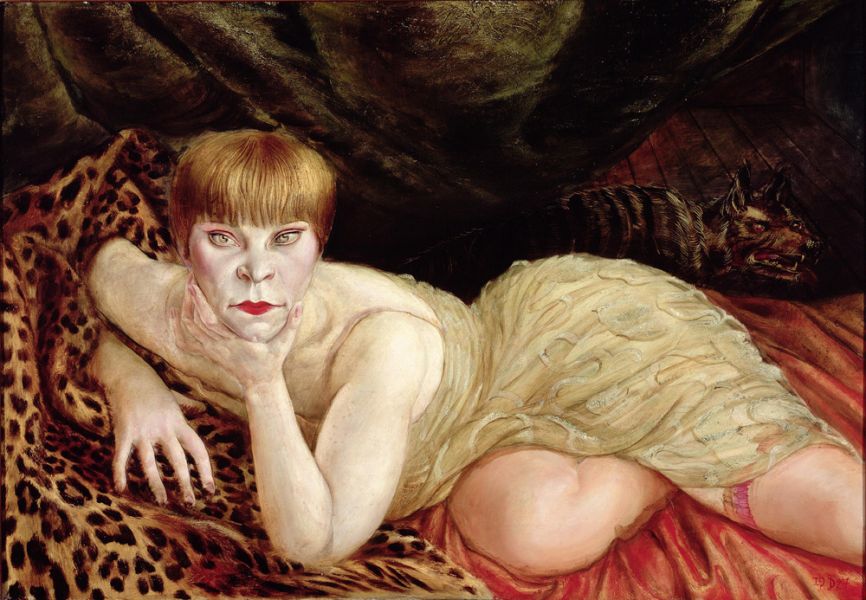
This piece is not as exaggerated as the one previous with the angle, but still shows an example of foreshortening. The model leans forward, her elbow and knee at the center of the image, upfront, as the rest of her limbs stretch away. An extension of the space she takes up. Its a unique angle and the painting is rather intimidating with the models somewhat harsh, direct contact. The body does somewhat direct the viewer, though it is not as clear as the previous painting as all the limbs extend into different directions, but the arm propping up the models head does draw a line of focus to her face. The bold red lipstick also helps to draw the viewers gaze. This composition feels a lot more intimate as the model is up close to the viewer, she is unescapable as she is in the center taking up the vast majority of the painting. Her cold stare combined with the dog in the background does create an air of hostility, the viewer may feel their presence is unwelcome by the woman, but the piece is also brimming with sexuality and desire.
Moving Forward
This exercise/ research has got me to really think about my composition, will it serve a narrative, will it direct the viewers gaze. Capturing the human form is more than depicting a body, it is using the body, to tell a story of direct the line of the viewers gaze. Foreshortening will be a useful tool to have in emphasising certain formal aspects of a drawing, areas of body parts I want to highlight or creating a line to follow. Furthermore, if I want to create a strong narrative within a piece of work, the body can help direct and assist this. The foreshortening can create an emphasis on the body, highlighting a theme, perhaps of sexuality and intimacy. There is a lot to think about with my compositions and foreshortening can assist with my visual language as an artist.
References
Saint Eulalia- John William Waterhouse- Waterhouse, J.W. (1885). Saint Eulalia. [Oil on canvas] Available at: https://www.tate.org.uk/art/art-terms/f/foreshortening [Accessed 2 Dec. 2020].
[1]- Tate (n.d.). Foreshortening – Art Term. [online] Tate. Available at: https://www.tate.org.uk/art/art-terms/f/foreshortening.
Reclining Woman on a Leopard Skin- Otto Dix- Dix, O. (1927). Liegende auf Leopardenfell (Reclining woman on a leopard skin). [Oil on panel] Available at: https://museum.cornell.edu/collections/modern-contemporary/20th-century-painting/reclining-woman-leopard-skin [Accessed 2 Dec. 2020].
 Simona Hopewell : Drawing 1