I really love being able to draw the body and capture the unique qualities that the human form can provide in comparison to still life and landscapes. The human form is so personal to us all, we can relate to depictions of the body and I feel we feel much more emotion for this subject matter compared to still life and landscapes. Drawings of the human form depict experiences, desires and something personal that can draw out a lot of emotion and relation from the viewer. The space between the viewer and these drawings/paintings is filled with emotion and understanding. There is a certain beauty to the human form that landscapes or still life can’t achieve.
This doesn’t just lie in the human aspect of these depictions, but also the historical context behind the human form. I love that there is always so much more to these drawings because of the context. What it means to be captured as a naked woman and a naked man adds so much depth that I love to unpack when observing such pieces. As a woman there is so much I can identify with my modern experiences as a female in historical paintings of women. How they are objectified and vilified for their femininity. The shaming of a woman from a masculine point of view. And these experiences cannot be applied to that of naked men, who are admirable in their paintings in contrast to the shaming and objectification of naked a woman.
Ways of seeing- John Berger
John Berger explores these ideas of the depiction of men and women in art and how different they are in his book ‘Way’s of seeing’.
‘the social presence of a woman is different in kind to that of a man’
A mans presence in paintings is usually linked to power, what power he has, the power he has over people. Men are to act in contrast to women who are to be seen. They are a sight. To be surveyed as Berger says in his writings. The viewpoint of women in the majority of classical paintings is masculine, it is how they are to be and are perceived by men. In turn how women view themselves and their value is defined by an internal masculine view. I feel this is still present, a lot of women hold an internal misogynistic view of what women should be by how they appear to men. As said by John Berger:
‘men act and women appear’.
Through many European nude paintings we can see ‘women have been seen and judged as sights’. We can see this with women making eye contact in paintings, acknowledging we can see her nakedness.
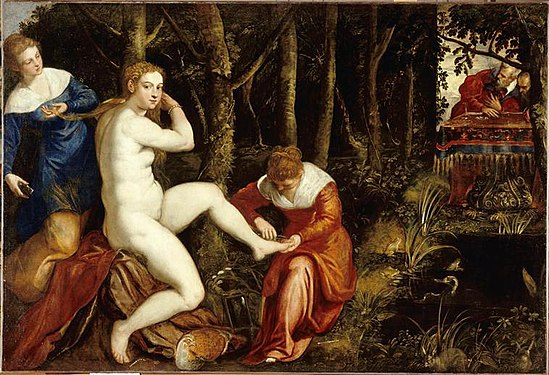
She acknowledges her nakedness by acknowledging the viewer. It takes away her innocence in a sense, making her accountable and to blame as she is aware.

In this second version by Tintoretto we can see Susanna’s use of a mirror, ‘thus she joins the spectators of herself’ ‘The mirror was often used as a symbol of the vanity of woman. The moralizing, however, was mostly hypocritical.’
‘you painted a naked woman because you enjoyed looking at her, you put a mirror on her hand and called it vanity , thus morally condemning the woman whose nakedness you had depicted for your own pleasure’.
Women are to be judged, objectified and used by men for pleasure and enjoyment. If a woman is to do the same to herself she is also shamed. It was an extremely sexist time, but some of that still lingers in present society.
The Nude: A new perspective- Gill Saunders
In this book, I was able to look at examples of nudes throughout time. We can see the progression from classical nudes to more modern approaches from the 20th century. The context does change, but I feel the objectification of women will always remain.
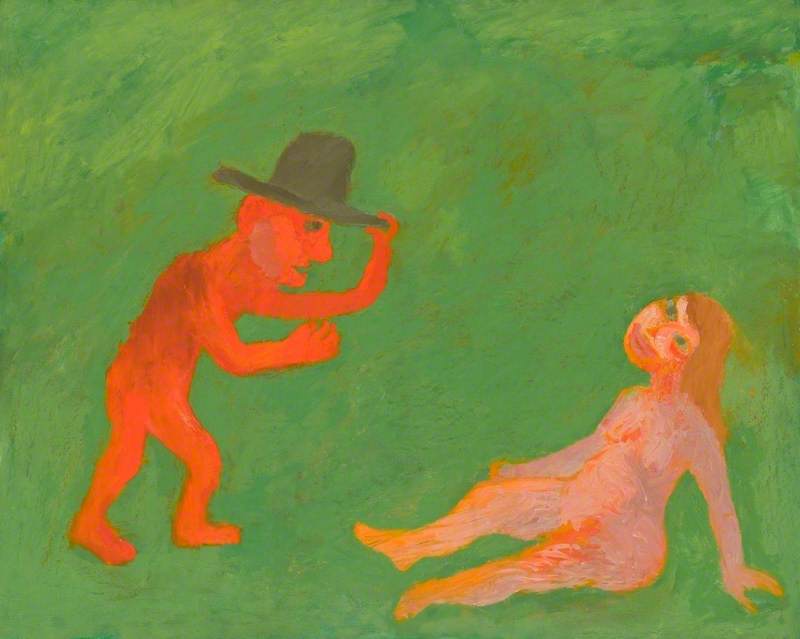
Kiff, K. (1965). Man greeting woman. [Oil, tempera and gesso on board] Available at: https://www.artuk.org/discover/artworks/man-greeting-woman-63705 [Accessed 18 Nov. 2020].
In this piece we can see that the man is depicted as guilty and to blame for his advances on the woman. He is red, an aggressive and sexual colour. The woman lays innocent and misinterpreted. ‘She offers a lipsticked mouth, conventional signifier of desire/ availability, but her expression is anxious and apprehensive’ .As Gill Saunders points out, it shows a turning point in depicting the relationship between depicted naked men and woman, showing the man as the aggressor and harasser, ‘we are alerted to the undercurrents of sexual dominance and harassment lurking in all social interaction between men and women.’ The woman is no longer the sole blame of her nakedness and the male gaze. The man is responsible for his misinterpretation, not the woman for her solely being naked.
As time has progressed so has the interpretation of the nude, but the subject became much more controversial. We can see in Kiff’s piece that the child like nature of the drawing adds a disturbing quality to the piece, as the content is so adult. Like you’ve walked in on an inappropriate situation.
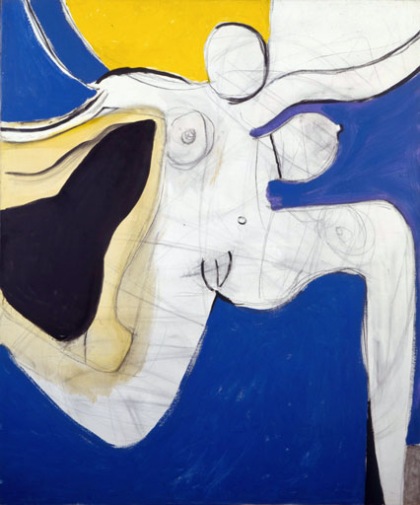
In this next piece by Roger Hilton, we see the body of the woman celebrated in a lively and exciting way. As Saunders describes in their book, the painting ‘celebrates her sexuality without being either a threat to the male or an overt invitation.’ , The woman is not so condemned as such in certain artworks from the 20th century, but the fetishization and objectification is still very present. By adding anonymity and taking away the females identity, the artists reduce women to an object, again as explored by John Berger, the female is reduced to a sight. Gill Saunders explores this idea also, saying ‘anonymity runs through the tradition of the female nude’, ‘Again and again the male artist reduces the female model to an object, to ‘it”.
Although some work has made progress on condemning women for their bodies, the women portrayed are still subject to being a sight for male pleasure.
Recent approaches to the female nude
I find that in recent approaches to the nude, they have remained honest, brutal and not so sexual, but the reality of the body. We can see this more in female artists such as Jenny Saville, whose depictions of the female nude feel real and not glamourized. There is a lot of heavy emotion present in her viewers who can see the bodies presented as bodies and not objectified or necessarily desirable.
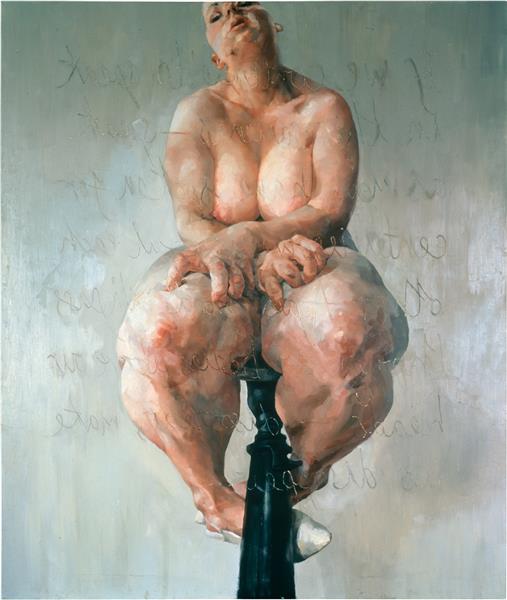
We can see this shift, especially from a female perspective, the the female body is not always desirable, attractive or fitted to the male gaze. Sometimes a body is just a body. The skillmanship in her painting is beautiful but the body is not. She has created an uncomfortable and what could be considered a grotesque view of the female body. It is something real and weighted in emotion. The space between the viewer and the painting would be thick with thought and judgement of the female body. Yet there is this relation and understanding between female viewers of this piece. With the context that this is a self portrait and her form is skewered to look larger (due to the artists inspiration of obese women in America) I can relate as a woman who struggles with my perception of my body, how I feel it is never good enough or slim enough. This is a real experience for many women, and it is a fresh take on the female form with the insight and gaze of a woman, rather than the fetishization of the male gaze.
Moving forward
Looking at what I want to achieve in this Part of the Drawing 1 module, I think there is a lot of inspiration and ideas to work with here. I need to think about what I want to say about the body with my work, do I want to objectify or present empowerment. Question the objectification of women? I would love to touch on those ideas if I had a female model to work with for Part 4, however I am working with a male model (restricted due to Covid). Therefore I want to look at creating a feeling of comfort and intimacy between the viewer and the model. To romanticise the male body, to present it as it is, and not as something powerful, but something real. I want to form a relationship between the viewer and the model. I want to fill the space between the two with emotions and warmth. I should look at what colours and medium would work best to do this but also play around with the composition of my model, what would best create this atmosphere of warmth, understanding and comfort.
References:
Ways of seeing, John Berger- Al, E. (2008). Ways of seeing : based on the BBC television series with John Berger. London: British Broadcasting Corporation.
Susanna and the Elders- Tintoretto (n.d.). Susanna and the Elders. [Oil on canvas] Available at: https://en.wikipedia.org/wiki/Susanna_and_the_Elders_(Tintoretto) [Accessed 18 Nov. 2020].
Susanna and the Elders – Tintoretto (n.d.). Susanna and the Elders. [Oil on canvas] Available at: https://en.wikipedia.org/wiki/Susanna_and_the_Elders_(Tintoretto) [Accessed 18 Nov. 2020].
The Nude: A new perspective, Gill Saunders- Gill Saunders (1989). The nude : a new perspective. Cambridge: Harper & Row.
Man Greeting Woman- Kiff, K. (1965). Man Greeting Woman. [Oil, tempera and gesso on board] Available at: https://www.artuk.org/discover/artworks/man-greeting-woman-63705 [Accessed 18 Nov. 2020].
Woman Dancing December- Hilton, R. (1963). Dancing Woman December. [Oil and charcoal on canvas] Available at: https://www.tate.org.uk/whats-on/tate-st-ives/exhibition/seeing-new-roger-hilton/roger-hilton-exhibition-guide/roger-1 [Accessed 19 Nov. 2020].
Propped-Jenny Saville- Saville, J. (1992). Propped. [Oil on canvas] Available at: https://www.wikiart.org/en/jenny-saville/propped-1992 [Accessed 19 Nov. 2020].
 Simona Hopewell : Drawing 1