The Czech Artist with his new exhibition at the Ikon Gallery, offers insight to the World around us by recycling old pieces of disposed technology (lights, circuit boards, wires and cables) in order to create a new vision of the world we live in. Some of his work having mythical or surreal elements, like a talking raven or ‘Nervous Trees’, made exploring the exhibition so much fun. However, I won’t be looking into those aspects of the exhibition today, I wanted to look at a select few pieces within this exhibition that look more closely at the depicting an Urban Environment and city-scapes that relate more to my current body of work for Part 3 of my Drawing module.
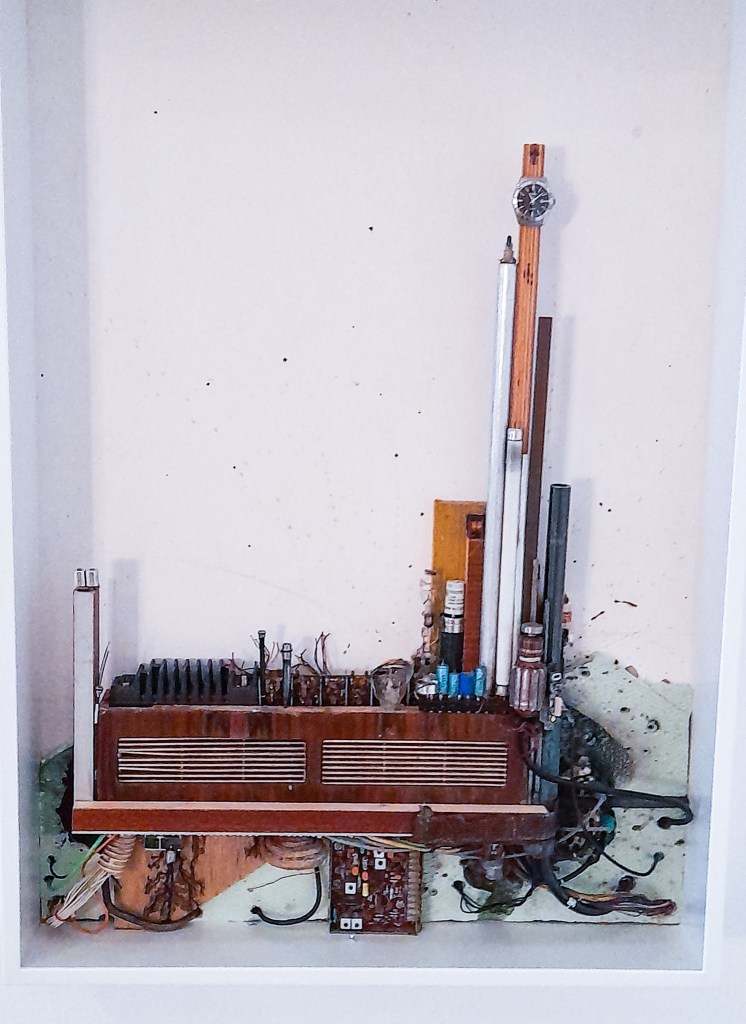
Piece 1 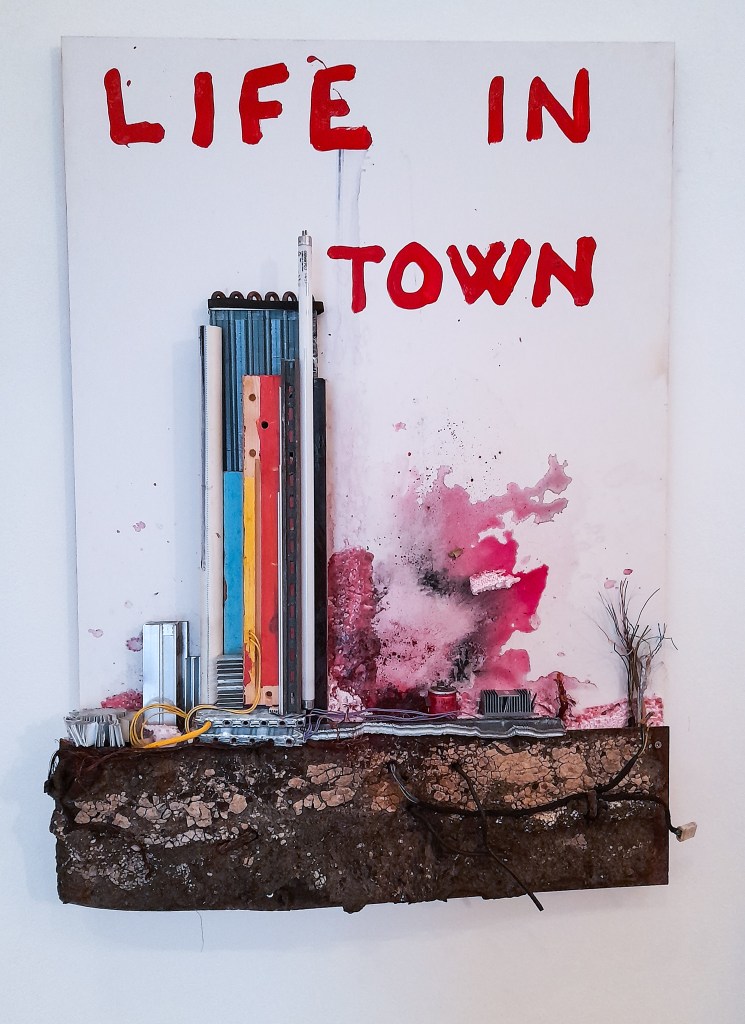
Piece 2 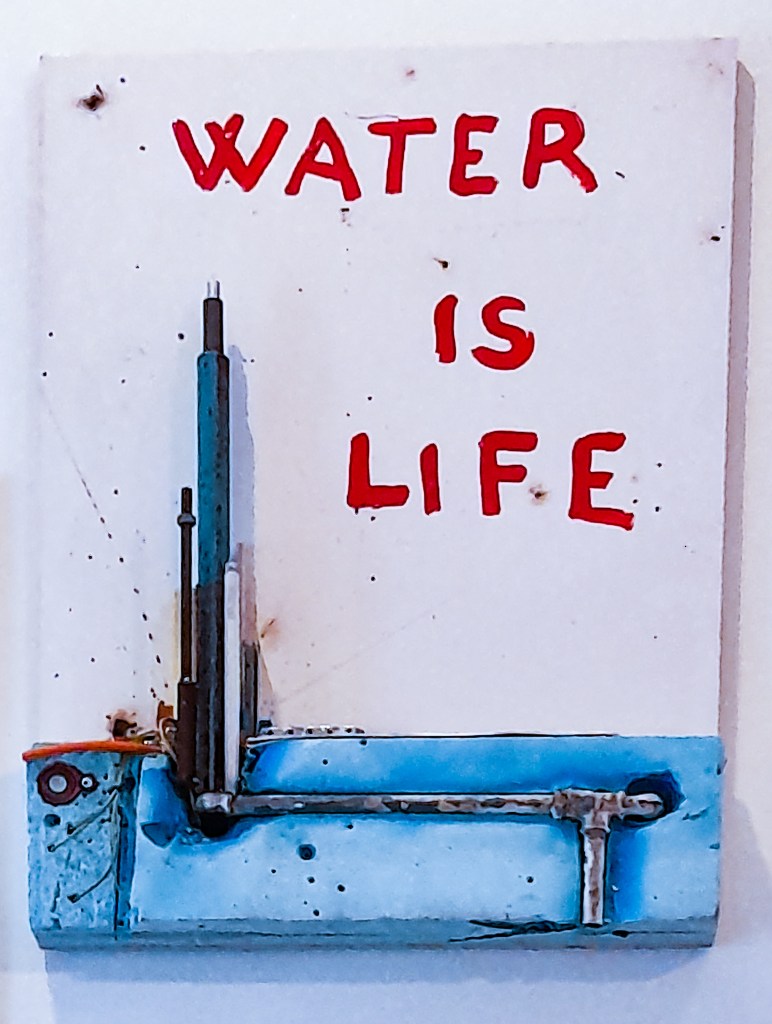
Piece 3
Framed ‘drawings’ using recycled pens, wires and metals and expanding foam.
The first three pieces I picked out here were the first ones I saw in this adventure of an exhibition. They depict city scapes and buildings using recycled materials and lots of wires. One of the unique areas where Kintera stands out is his use of recycled materials to depict scenes. The vast majority of what makes up his work is recycled materials that can’t serve their purpose anymore, and Kintera gives them a beautiful new meaning by using them as art and to make his art. His depictions of city-scapes and buildings are unique not only due to what they’re made out of, but also due to how Kintera also focuses on whats underneath the city. A city isn’t just what we can see, its the invisible parts that we aren’t always aware of, like water lines, sewage pipes and electricity which reaches us and connects us underground. When we think of a city we think of the buildings we can see, not the aspects underground that make cities function and work, which is a unique take by Kintera I haven’t seen many or any landscape artists focus on.
These pieces are so interesting to me as he has dissected the Urban Landscape to show us aspects of city structures we don’t always think of, and show their importance. The 3D aspects of these pieces, by using wires add so much depth and texture, you find yourself staring for a long while picking out each object he uses whether its a broken phone, wires or an old motherboard.
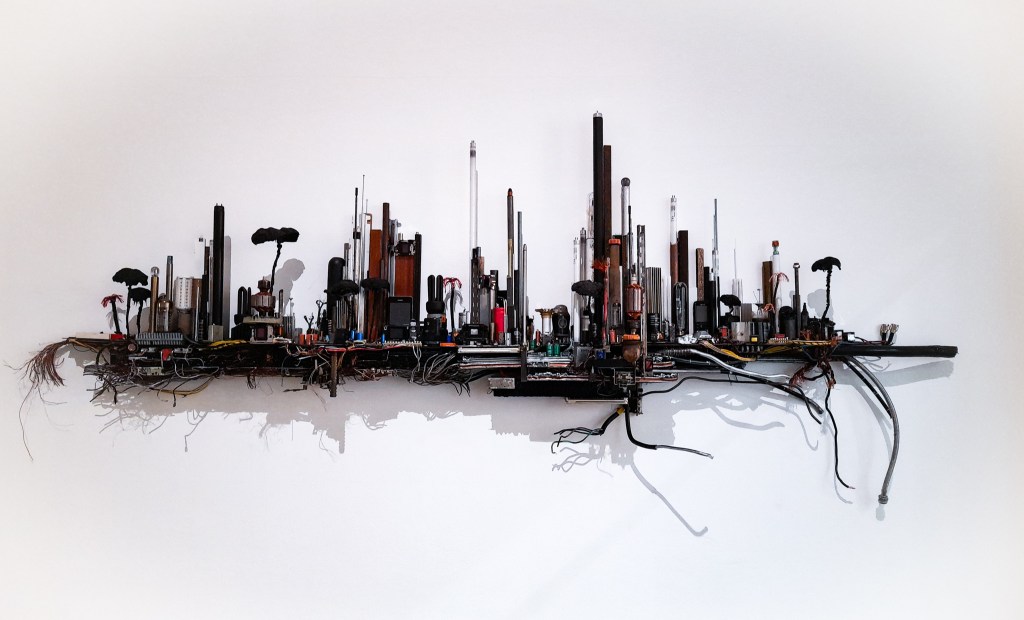
Wall sculpture made from recycled materials
Here we can see a direct advancement from the framed pieces I looked at first. He’s moved on from looking at one city building to looking at a city silhouette, a slice of a bigger scene. This piece shows how we’re all connected by these wires, pipelines architecturally but also by the technology we use. We can all find an item we can relate to that is used in this piece. For me and my boyfriend (who accompanied me to this exhibition) we both found and bonded over an old camera that was repurposed in this piece. We are all connected by technology and the internet but also by the design of our towns and cities.
Again Kintera uses wires and 3D objects to add layers of texture and perspective to his work. He uses the texture of different materials, like indents and parts of a computer board to act as windows and building textures, there is a lot of detail to unpack when you’re close and personal with his work, which adds so much investment and intrigue to the viewer.
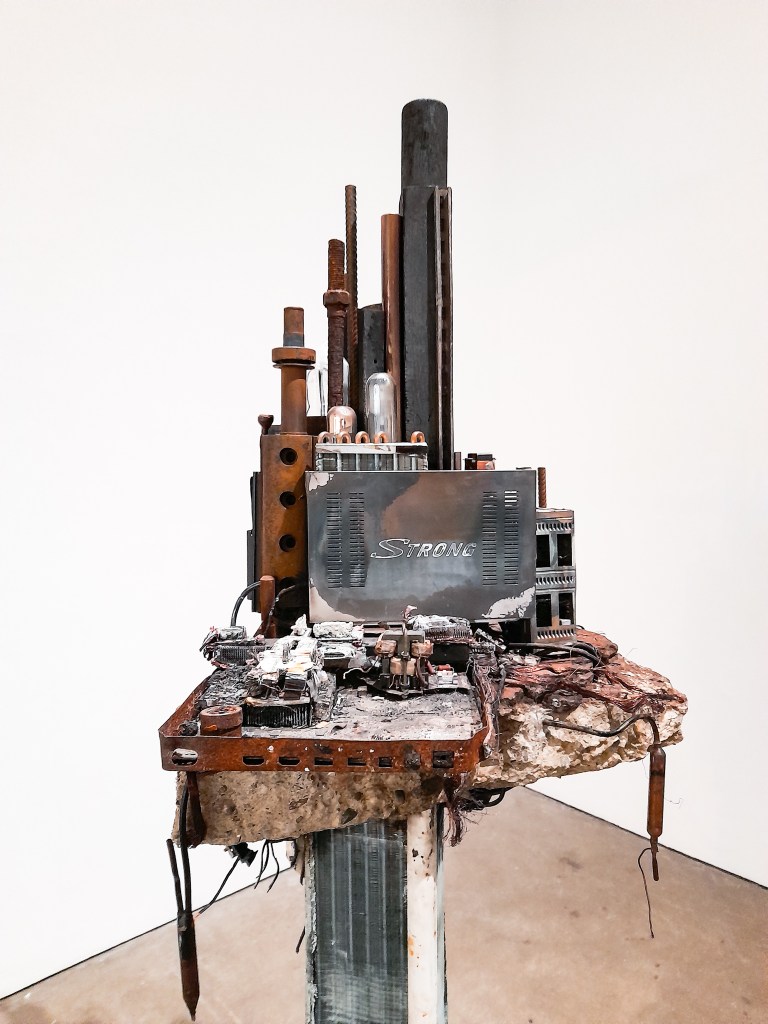
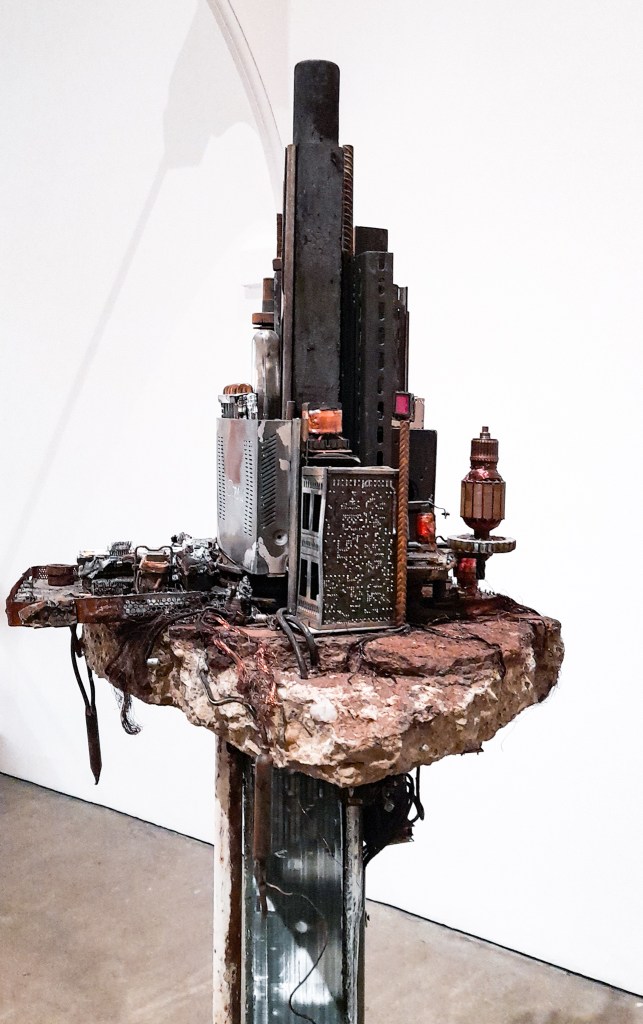
Sculpture made from recycled materials
As I moved throughout the exhibition I could see the advancement of his ideas and how he progressed from previous pieces. I loved looking at this piece and found how the longer I stared the more I could identify and recognise. It adds a layer of interest to the viewer to recreate structures we recognise with old nostalgic objects we have discarded long ago, old cameras that we have outgrown due to the advancement of technology. It shows us how we are advancing at such a fast rate with technology we don’t think of what to do with older pieces which we don’t value anymore. Kintera looks at giving value back to these discarded objects and comments on how we should think about an old piece of technology before we send it to landfill site. Can it be recycled? Can I find a new use for it? Can I use some of the pieces its made of for something else? It also shows us how we have gotten where we are from this technology, out cities are made from all this technology we deem useless now. So is it really useless if it has gotten us to where we are now?
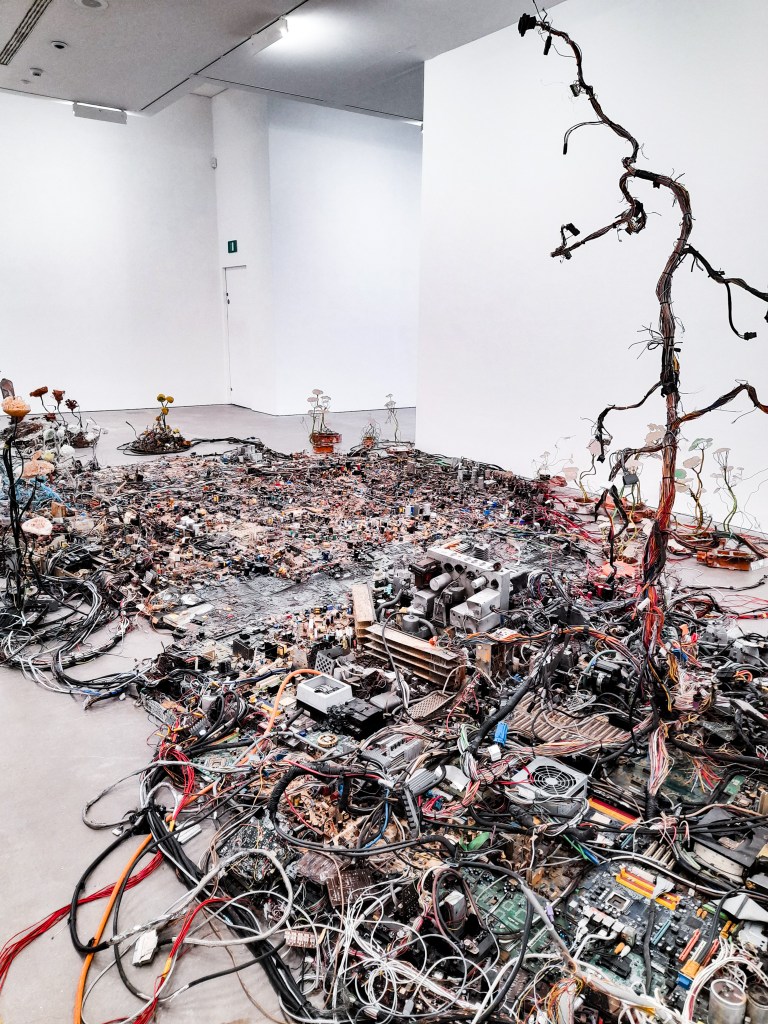
Large model of a city made from recycled materials.
Finally we can see this growth and ideas fall into place with the final piece I will look at, this huge model city made again from recycled materials. I love how you can see his thought process and journey of ideas advance as you progress through the exhibition. There is so much to unpack visually that I found we stayed here the longest, exploring this vast city like a city in a foreign country. Familiar yet different, it was exciting seeing how he explored different landscapes with different recycled materials. Fields made from flat, green circuit boards. Cities made from old computer pieces and hardware, which depict buildings and skyscrapers from how he organises his composition. Wires connect the different cities and landscapes, joining them all together. Wired trees are present showing the need for nature, but also the absence of it in a modern and technologically advanced society. His work contains juxtaposition by showing a sci-fi, technological advanced society but made up of discarded technology that’s old and serves us no purpose anymore. From the title: ‘Postnaturalia’ we can tell that this is a city depicted after nature. There is no need for it yet we long for it. It comments on how we rely on technology more than we rely on the environment, and although we value technology, we discard it and disregard it the way we do with our natural environment.
I haven’t enjoyed an exhibition as much as I have with this. I highly recommend this to anyone with an interest in art. It was insightful and deep as well as being playful. The work was visually stimulating and it has made me think about my approach to landscapes and how there is so much more to explore and take into consideration. How my materials can help change or add new meaning to my work. I am so glad I visited and have had my mind opened to new possibilities and ways to explore landscapes and city-scapes. How I can create my own medium and explore new ways to create and ‘draw’ outside of traditional media. ‘The end of fun’ is definitely insightful, deep but also ,ironically, a whole lot of fun.
 Simona Hopewell : Drawing 1