One Artist whose work has really stuck out to me is John Virtue, I love how messy and abstract his work first appears and then how the modern landscape of London begins to form the longer you look.
His work has a historic feel to it while also remaining new and fresh, with his black and white approach to his paintings they feel reminiscent of lithographs and ink press prints used throughout history. This makes sense with his main influences being Turner and Constable and his references to ‘the Dutch and Flemish landscapes of Ruisdael, Koninck and Rubens.’ [1] . Traditional approaches to landscapes helps him to create unique depictions of the modern, fast changing environment of cities in the present.
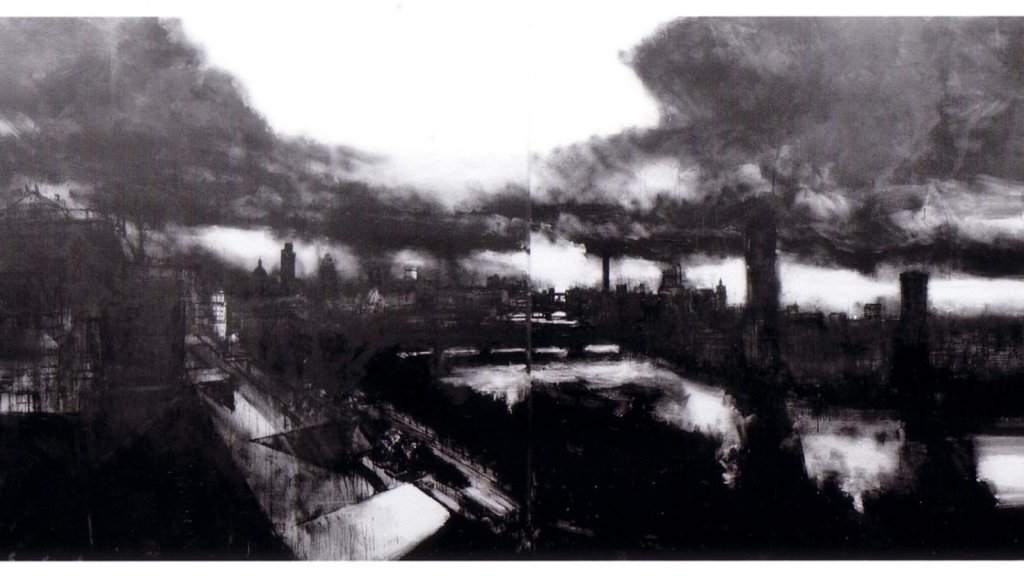
By working in solely black and white, it is clear his focus isn’t necessarily on the landscapes but rather light, and how catches and plays with the shapes of London. This piece of his works so well to show the industrial cityscape along the Thames, his use of ink and no colour give it an industrial vibe. His choice of medium and how dirty it looks when combined with the white acrylic suggests within his work, how dirty and polluted London is.
Many contemporary Artists and their approach to the ‘Urban Environment’ often highlight the dirtiness of urban landscapes compared to the beauty of the natural landscapes historical Artists often depicted. There is a cleanness to nature, and a gritty dirtiness to an urban landscape. With industrialisation of cities comes pollution, with people comes dirt and litter. Contemporary Artists are not afraid to highlight and focus on the harsh reality of how unappealing and dirty modern and urban landscapes are. An Artist I looked at when first looking at landscapes also highlighted this within his paintings.
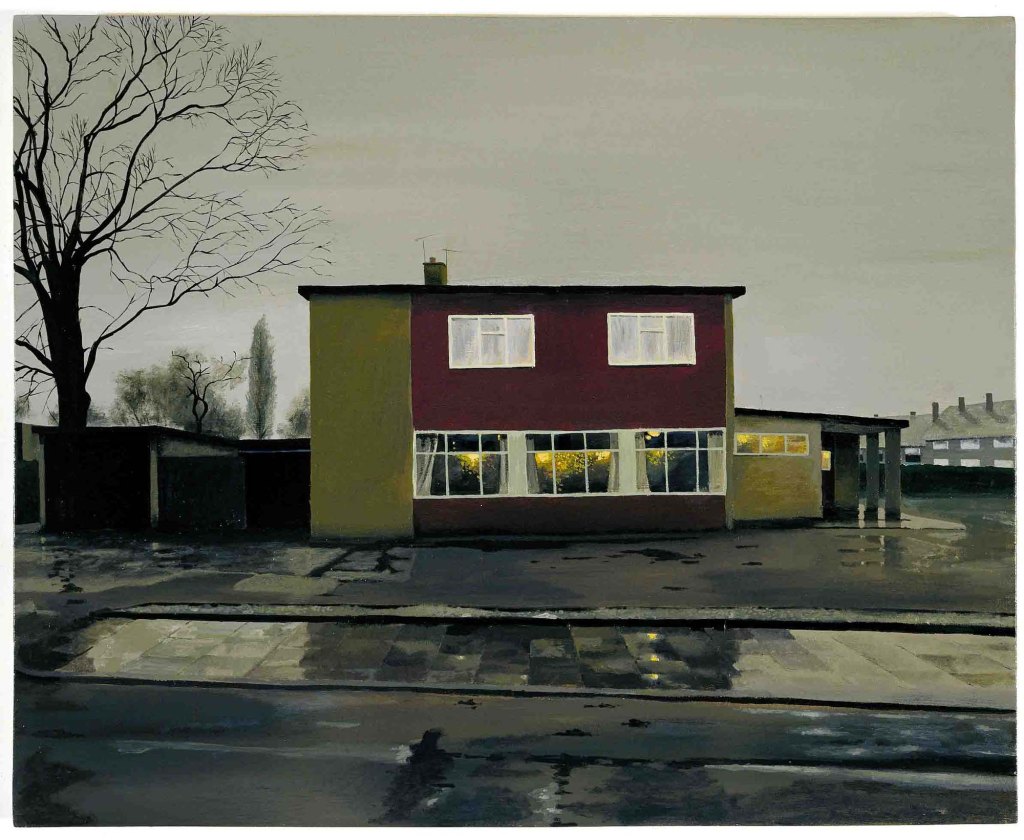
George Shaw keeps a focus on urban environments within his stunning pieces. They showcase housing estates, often filled with litter, graffiti and not the most scenic areas. They are filled with low income families and aren’t visually appealing or seen as beautiful. We can see this in Shaw’s work, but I feel he also discretely does the opposite. The absence of people creates a lonely but tranquil atmosphere within his work. He adds a sense of beauty, often absent in artwork looking at urban environments, by looking to areas and aspects of our daily lives that we often overlook. The care and attention to detail he applies to scenes we see everyday and overlook as we rush about our lives adds so much to the mundane, it makes it worthy of being looked at when we don’t bother to.
It’s hard to capture beauty and interest in views we are so familiar with, George Shaw and John Virtue both offer insights to these scenes with their work. They showcase the reality of how dirty city landscapes are but they also show the beauty of these landscapes in their own ways. Virtue’s attention to tone shows us that we should look more at the city around us and find light in the dark, good in the bad, and really look at the view, as there is more than meets the eye. Shaw, shows us that beauty can be found in the mundane if we take the time to look and see what we normally wouldn’t pay attention too. To capture the modern landscape as a contemporary artist is to highlight the reality of our environments but also show the sublime beauty and from the attention and care they have took of capturing a view like that, which every British person has seen and is familiar with. That familiarity with a cityscape is what helps the viewer and the artist identify with one another.
Moving Forward
As I begin to look at cityscapes and the landscapes of a modern environment I should really take into consideration these Artists and their approaches. I should look at how the historical artists have captured the beauty of traditional and natural landscapes and how contemporary artists apply this with modern approaches to a more gritty and urban landscape. I want to, as mentioned before, look into ink and lookign at John Virtue’s style and applying it to my work. I want to keep a big focus on tone and how light interacts with a scene, this can be done best with a black and white colour palette which I have been exploring so far in pen. I would like to branch this out and maybe combine pen and ink to really explore an urban landscape for myself as an artist. I could also take into consideration George Shaw’s approach and look at everyday aspects of city life and the environment and capturing that rather than a greater scene. I could use that focal point to really capture the more subtle aspects of a city scene that go overlooked. I want to capture Birmingham in the next few exercises looking at a townscape as it is where I have really developed and grown as an Artist and is a place I am very familiar with.
Source [1] – http://www.nationalgallery.org.uk. (n.d.). John Virtue | Associate Artist Scheme | National Gallery, London. [online] Available at: https://www.nationalgallery.org.uk/learning/associate-artist-scheme/john-virtue.
 Simona Hopewell : Drawing 1