I think that you can learn a lot and discover new things about Art and approaches to Landscapes by comparing different approaches and how they have changed through history. I found my recent Artist Research looking at historical and contemporary approaches was useful in seeing how art styles vary and differ as time and art progressed, and it will be useful to really compare how, and what techniques are prevalent and where areas of focus have switched and changed with Artists approach to landscapes.
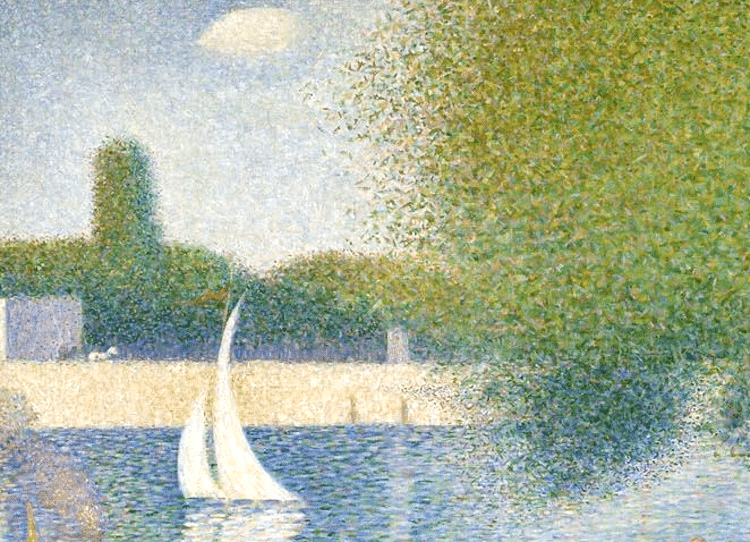
Tacita Dean compared to George Seurat
Seurat 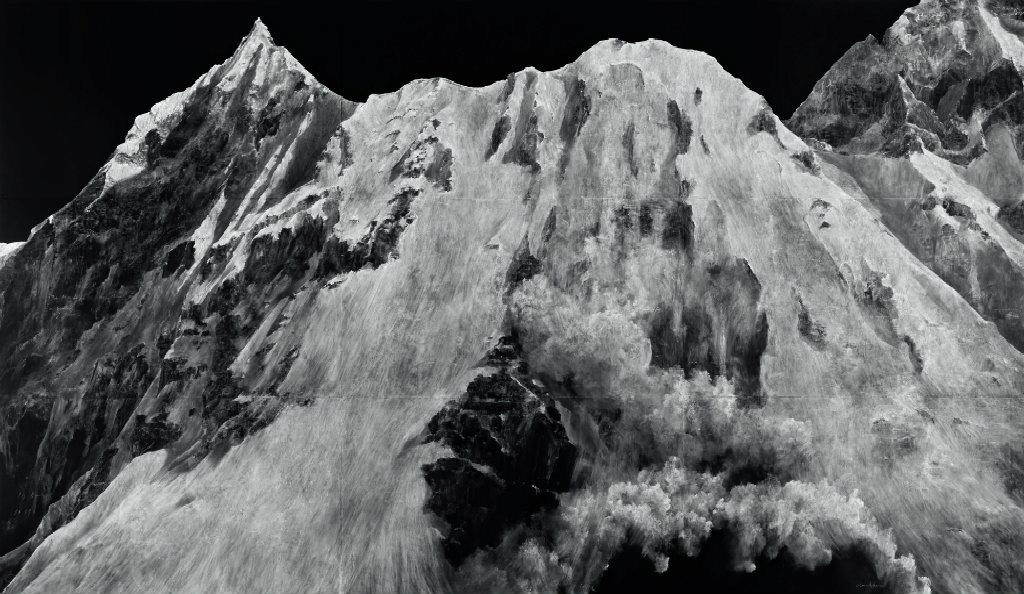
Dean
Painting 2- Dean- Dean, T. (2012). Fatigues. [Chalk on blackboard] Available at: https://www.culturewhisper.com/r/visual_arts/tacita_dean_landscape_royal_academy_of_arts/11715 [Accessed 23 Sep. 2020].
Initially it is clear that historical interpretations of landscapes, particularly from the impressionist movement, tend to involve lots of bright, pastel colours, and soft marks to make up the landscape, which holds a romanticised feel and vibe to many 19th century landscapes. I do like the approach and the gentle approach and care many of these Artists, some I’ve looked at before, have towards landscapes. Seurat’s work is a love letter to the landscapes he depicts, portraying the beauty he finds in the world around him, compared to the harsher depictions modern Artists opt for. The time consuming approach he took, being the pioneer of pointillism, shows a fondness and a joy for the landscape he depicts, compared to the harsher, monochromatic approach Dean and many contemporary Artists use.
Dean’s odd choice in medium (chalk on a chalkboard) helps her to create a texture similar to the rough rocky mountains she depicts in her ‘Fatigue’ series. It is something that I would lean towards in terms of inspiration and the direction I want to head in with my drawings and work on landscapes. Her goal seems very orientated in capturing the rough, ruggedness that mountain ranges hold, she wants to capture realism and accuracy in her depictions, compared to Seurat’s landscape which seems to be about creating a feeling rather than accuracy. His approach seems dreamlike, and wanting to depict an ideal place to be; somewhere warm and scenic a pleasant stroll through a park. The opposite of showing the harsh and cold terrain of a mountain range.
The drawings seem to hold different purposes, which can reflect a more serious approach from current artists, and wanting to depict reality when it comes to landscapes. Artists from the past, specifically 19th century artists within the impressionist movement, want to create more of a feeling and and emotional reaction from their audience, usually a pleasant one. I could take this into consideration and really think about what I want an audience or viewer to gain from my work. DO I want to create a specific feeling of like happiness or stress, or go for a depiction of reality which is a common theme of contemporary Artists.
John Virtue compared to L.S Lowry

John Virtue 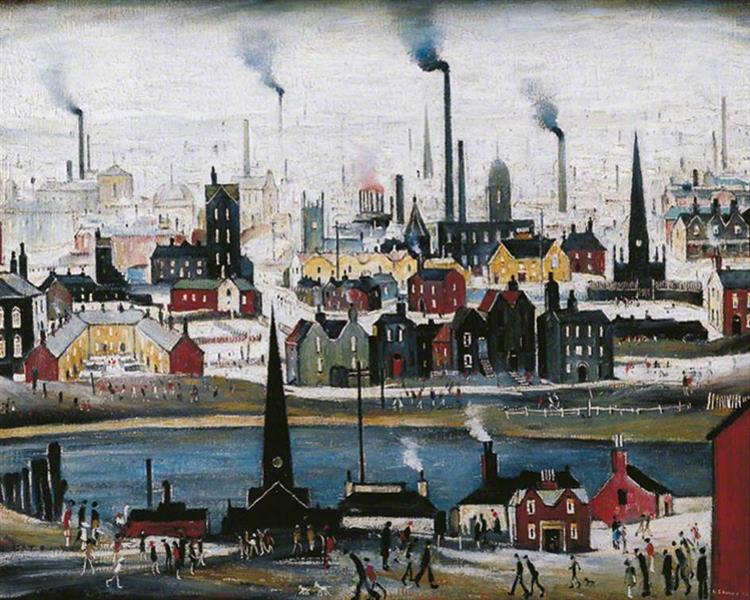
L.S Lowry
Virtue, J. (2004). Landscape No.739. [Acrylic & shellac on canvas] Available at: https://artuk.org/discover/artworks/landscape-no-739-219454/search/actor:virtue-john-b-1947-61730/page/1/view_as/grid [Accessed 23 Sep. 2020].
Painting 2- L.S Lowry – Lowry, L.S. (1945). Industrial Landscape. The Canal. [Oil on canvas] Available at: https://www.wikiart.org/en/l-s-lowry/industrial-landscape-the-canal-1945 [Accessed 23 Sep. 2020].
Both of these approaches to landscapes have a similar subject matter of an industrial cityscape with wildly different approaches. Lowry goes for a primitivism approach with a very naive/childlike style, which simplifies the view and uses colours to evoke a feeling from the viewer. Which is similar to Virtue’s intention with his work. Both showcase a city scene as a dirty, polluted landscape, we can see this in Virtues work as the black used looks smoggy and dirty in some areas. Virtue’s approach to a landscape is quite expressive but still captures realism in his use of tone where as Lowry focuses more on showing the whole picture with his child like style and approach. Historical 19th century Artists again opted for a stylised way of presenting landscapes compared to a much more gritty and realistic approach used by many contemporary artists.
I do not like Lowry’s style personally, but I can appreciate it and its uniqueness. I feel my style does fall into the more contemporary styles I have looked at so far, but I do love the impressionist approach to landscapes. Maybe that is something I could explore with colour and oil pastels moving forward but I feel within the drawing module and Landscapes I prefer the more contemporary approach with a focus on tone, texture and a sense of realism. Looking to the past and to the current has given me ideas I want to play around with but also encourage me to move forward in confidence with what I’d like to do with my current ideas and medium choice. Comparing Artists was useful in seeing how stylised certain historical Artists were and what key elements are looked at and focused on by Artists working today. It’s given me lots of ideas and contextual knowledge that I can utilise and think on as I progress with my work and skills.
 Simona Hopewell : Drawing 1