Ocean 1975
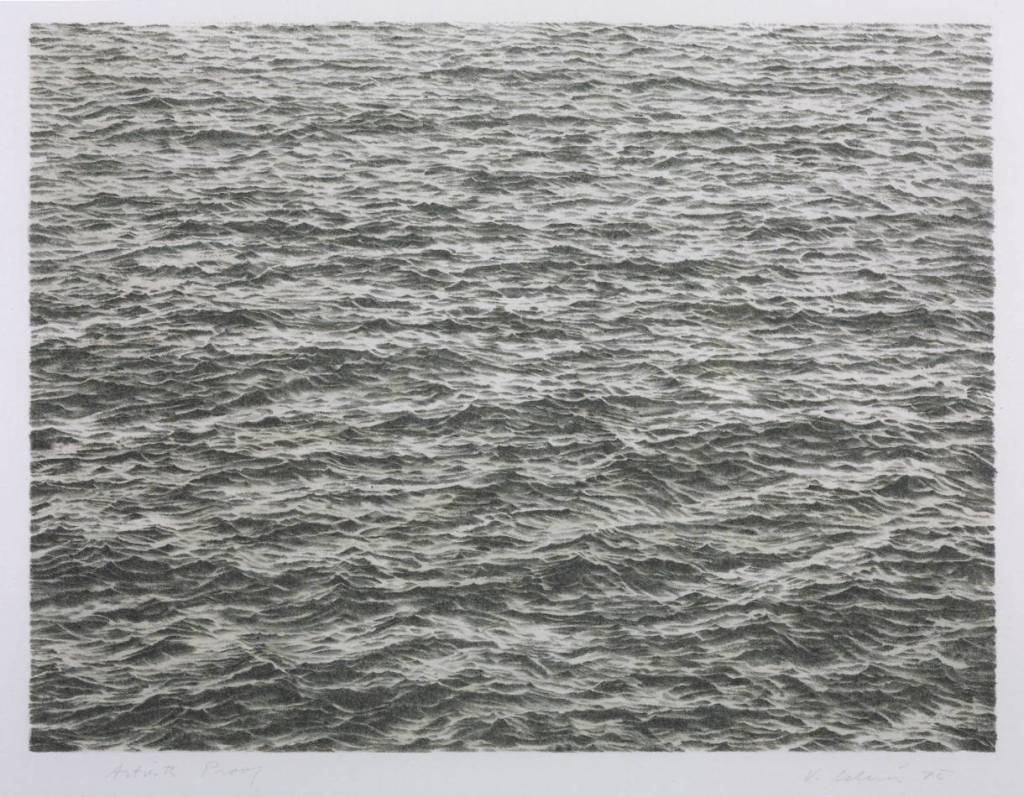
Celmins, V. (1975). Ocean. [dry point on paper] Available at: https://www.tate.org.uk/art/artists/vija-celmins-2731 [Accessed 13 Aug. 2020].
I love the simplicity of her composition combined with complicated details. She captures the movement and shape of the water beautifully using fluid lines which gesture towards the natural form of the seascape. The composition is simple, with a magnified view of the sea, the focus lying on the texture created by Celmin’s use of tone. The texture is emphasised by the tone, created with a strong focus of areas of light and dark. I could try and create a detailed focus on the tone of my pieces, maybe create an interesting composition by keeping a tight, focused view of the natural landscape rather than a broad one. By keeping the subject matter focused and concentrated on one type of natural form, I could create an interesting piece that stands out to the viewer as this piece does so well. Her work can be quite abstract from afar but still recognisable as a natural form.
The monotone works well to emphasise the texture and keep the focus on the form and tonal aspects of the natural seascape . I have been working with a monotone palette for my sketches so far in Part 3 and I would love to continue exploring this, I find by keeping a monotone approach of tone and texture it allows the shapes to really pop in my drawings. Natural textures are very random and complicated compared to man made textures, and are hard for me to accurately portray, so I have been staying focused on the natural shapes within a landscape than the texture. I could try to begin developing a focus within my drawings on the texture of nature that can be observed everywhere.
As Celmins describes in the suggested video on Vimeo, her work is not copying but is ‘Re-describing’ which I feel is important to take from her discussions about her work and applying it to any art looking at natural form. I feel with drawings you’re never going to get the texture of tree bark or all of the blades of grass accurate and precise. So approaching your work as a retelling of it with your medium choice is a good approach in not getting too caught up in all the fine details.
Desert 1975
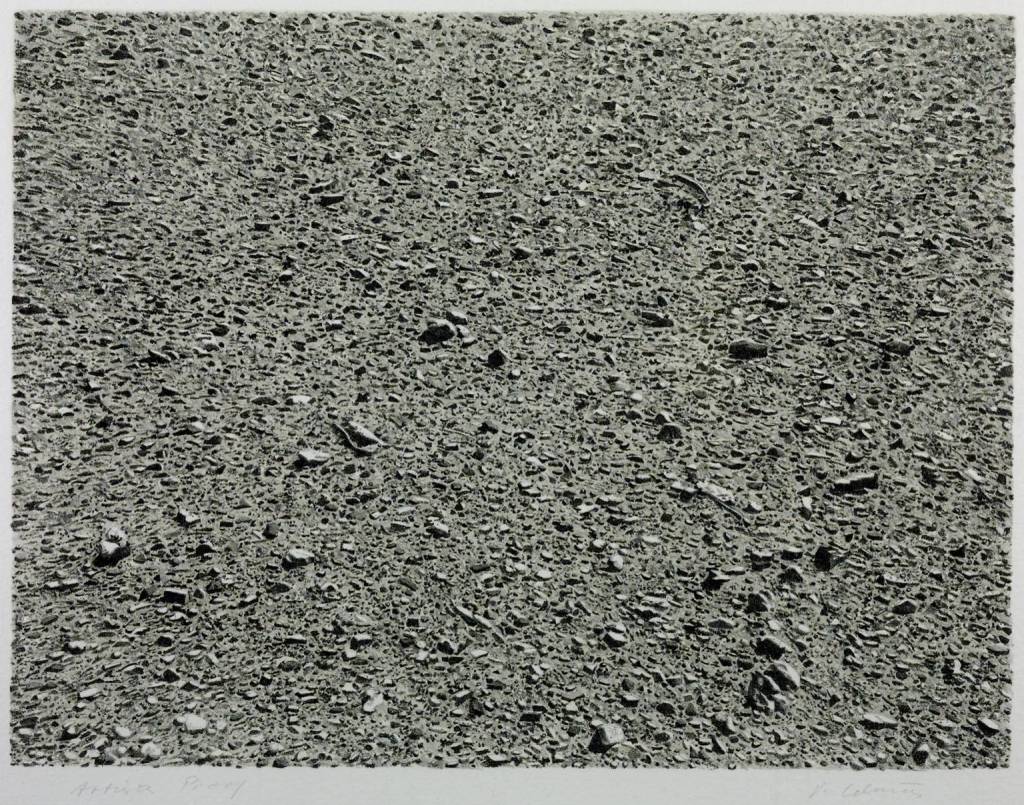
Celmins, V. (1975). Desert. [Lithograph on paper] Available at: https://www.tate.org.uk/art/artworks/celmins-desert-p78337 [Accessed 10 Sep. 2020].
This piece again, is just a snippet of a larger view, and when gazed upon the viewer cannot help but to imagine the broader picture of the landscape, horizon and the sun beaming down. Again a huge emphasis on areas of light and dark to make this piece come together work so well. What I really like is that there is no clear focal point, your eyes just gaze across the piece to different areas, drawn to the bigger areas of shadow being cast by the larger rocks. I think its a unique approach to landscape which shows skillmanship and the importance of compositions which don’t necessarily have a narrative or traditional landscape composition.
Moving forwards
For my drawings I could think about trying to focus on a smaller area with the focus on detail and the texture nature, rather than the ‘scene’ of nature. I want to take time to work on textures of numerous natural objects, like my next exercise looking at clouds, and focus on depicting an accurate texture that adds to the realism of the landscapes I want to ‘re-describe’. I love Vija Celmins work and I would love to incorporate some of her style into my work, by keeping to a monochrome palette and really focusing on my use of tone, boiling it down to areas of light and dark to effectively present my landscapes.
 Simona Hopewell : Drawing 1