Exercise 1
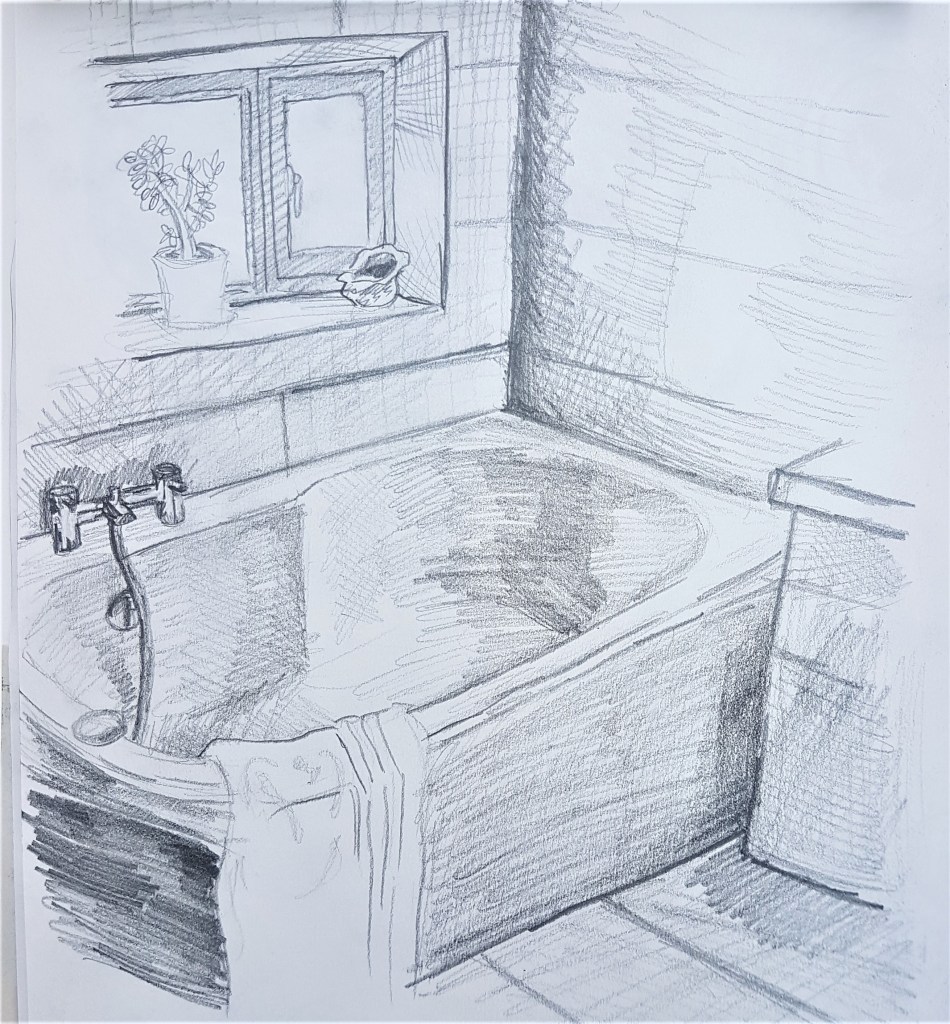
For this exercise I began in my bathroom, doing live drawings from different angles in the room, moving around as I quickly sketch what I see in my sketch book. I found it quite refreshing to not be focusing on the detail but my observational skills, quickly depicting the room, the lighting and the shapes that make up the space.
The upstairs bathroom-
[1] 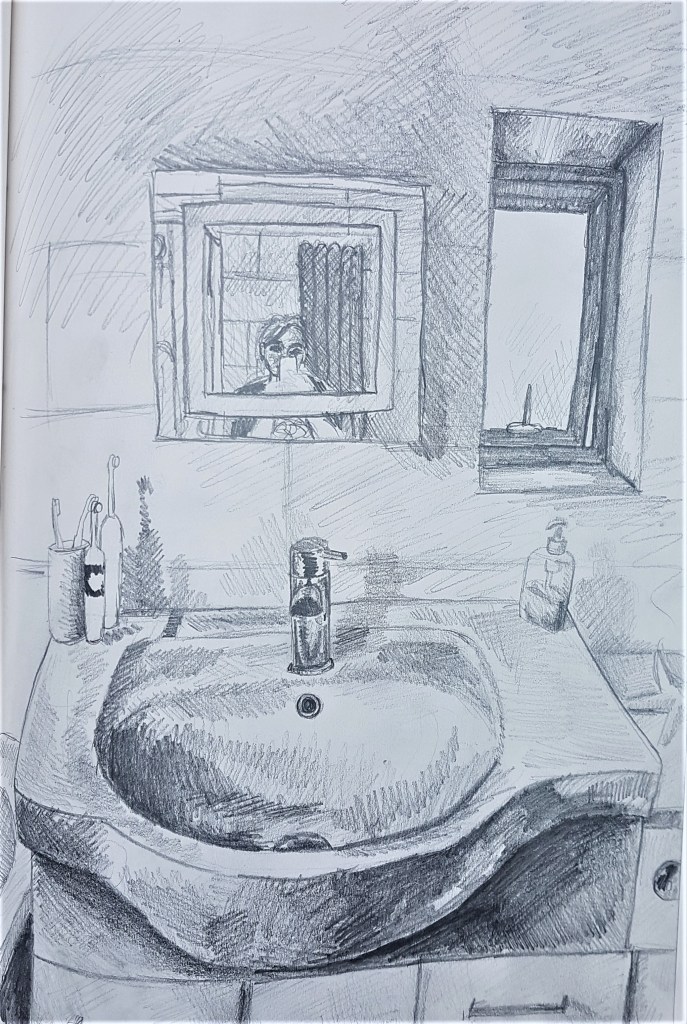
[2] 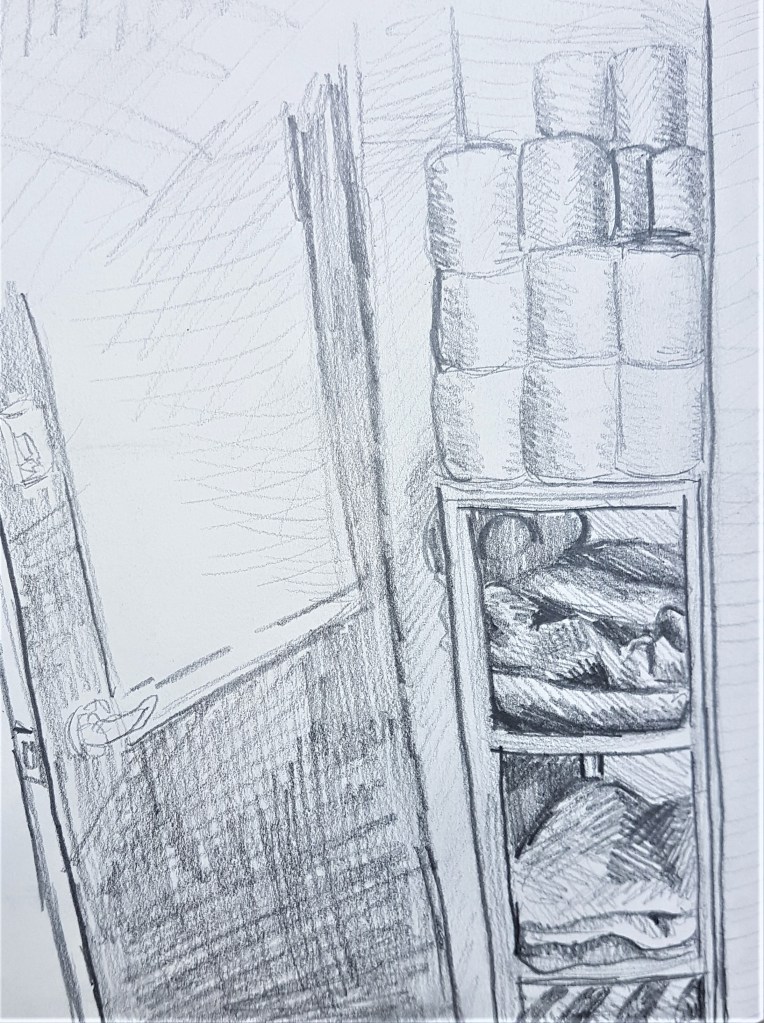
[3] 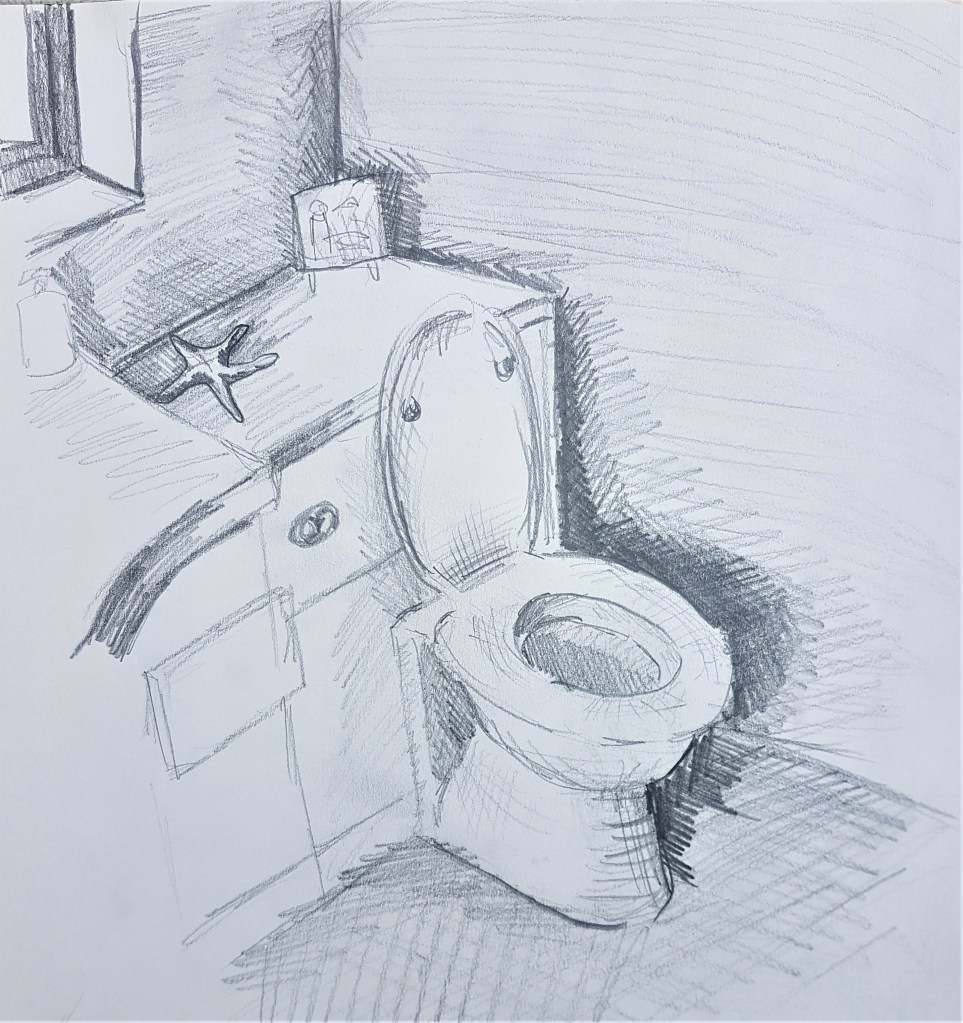
[4]
Pencil on paper
I quite liked how these drawing came out, it was a huge change of pace to focus on loose drawings capturing a larger scale still life, a room, and I really enjoyed the process and looking at the different angles. Although I feel in places my proportions are slightly off, I do love the looseness and experimentive markings in live sketching. For the second drawing, I did need to resort to using a photo reference as well for how I wanted the composition to be underneath the viewer to have a better view of the sink and due to the lighting fading in and out.
Because of the type of the type of drawings they are, live sketches, I wasn’t feeling as pressured to make an excellent proper drawing and could really be free with my markings and not worry as much about getting everything perfect. However that’s not to say I wasn’t frustrated looking back when I finished the exercise and seeing the flaws in my proportions and the drawings. It is quite difficult to get the drawings perfectly accurate when trying to keep to a loose carefree style, but I feel my proportions did improve as I moved forward with the exercise.
I attempted these studies around 7pm, since its summer, this meant the sun was slowly setting, beginning to cast long shadows on the walls. This meant I could play around with the drawing tonally and I feel it made my sketches come across more authentic and real in the loose style.
With this exercise I also enjoyed not having to think too much about my composition and setting one up, as the scene had essentially already been made for me, so that meant I could just start sketching away and have the pressure taken off of me in terms of thinking about constructing a composition myself. For this room, I kept to using straight sharp lines to define certain shapes within the room, but kept my markings looser for adding tonal value to the sketches. I decided for my next room study, I could time myself in order to really focus on the shapes of the composition and room, instead of getting carried away with tone, which I tend to do. I wanted to be able to really focus on the shapes.
The kitchen- timed sketches
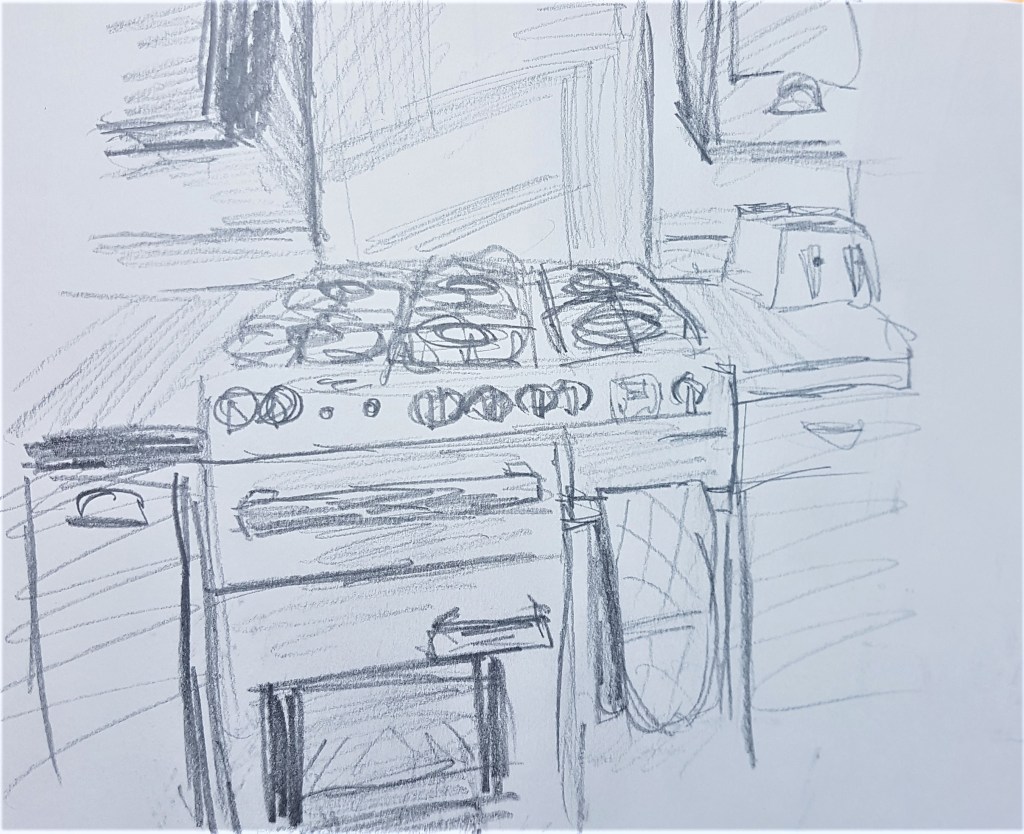
[1] 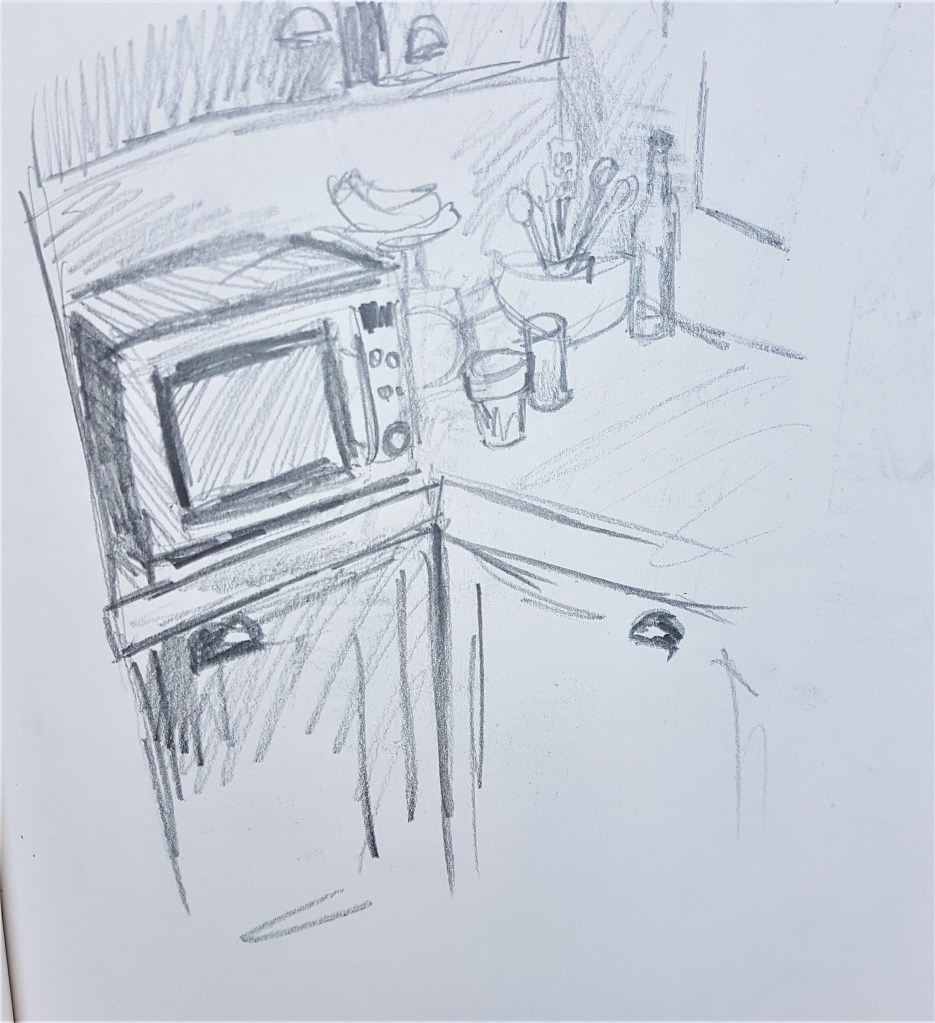
[2]
pencil on paper
I found timing the sketch really helped me to focus on the shapes and lines of my drawing, and how effectively I was showing the room, I barely used tone, which was good for me to know I was focused on the area that I wanted to be. For sketch [1] I gave myself 5 minutes to draw, which you think would feel longer than it is, but its a really short amount of time, however, I manged to get in all the details of the oven (loosely).
For sketch [2] I knocked the time down to 2 minutes, I feel the difference is much more noticeable as the proportions for this drawing are a lot more skewered.
My technique became a lot looser, almost like a continual line drawing, with a shorter amount of time to get everything in. I do like the effect to a certain extent but my drawings here look a lot more childlike. I also ended up focusing on a much smaller area of the room rather than a vast corner like previously, i think this due to me trying to fit everything in, but also due to my kitchen not being as open a space as my bathroom. I’m happy with how this came out, as it was just an experiment with capturing a space.
Moving onto my next exercise, I wanted to focus on a more dynamic room composition so I thought my stairs could be a good area to focus in on as there are lots of different angles and perceptions of the composition I could play around with.
Exercise 2- Composition: An interior
For this exercise I decided to focus on my stairs as I can really change my perspective and view as I climb up and down them, which will give me a lot to work with .
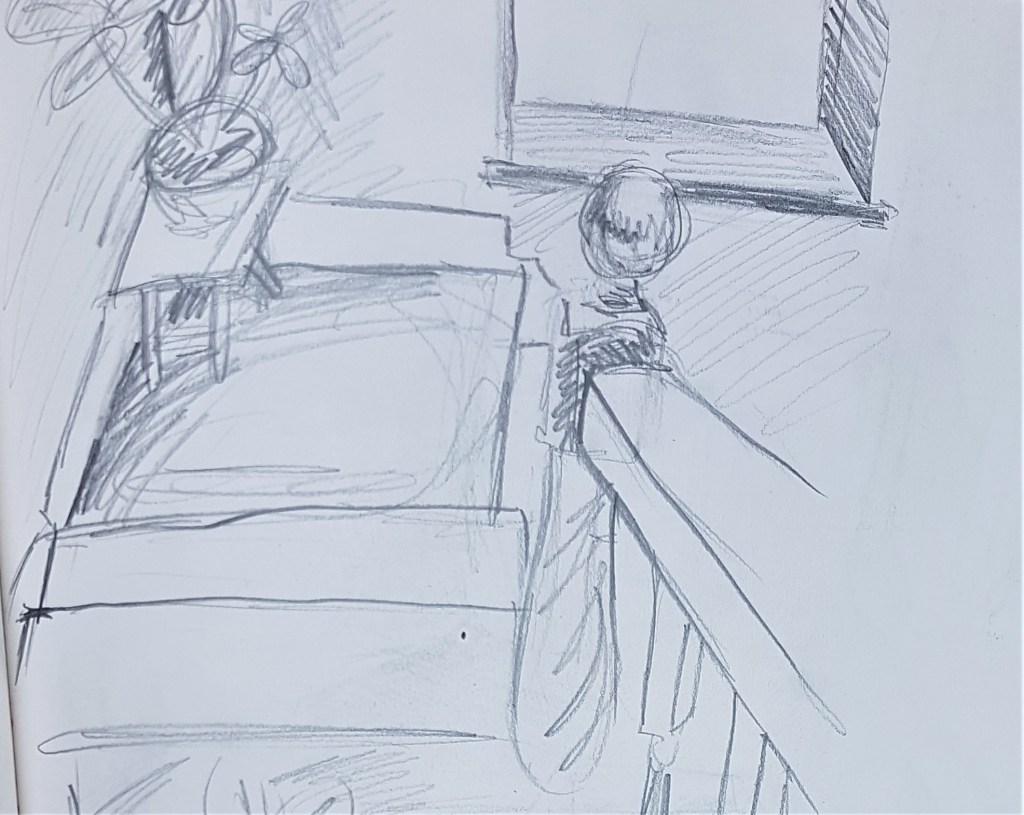
[1] 
[2] 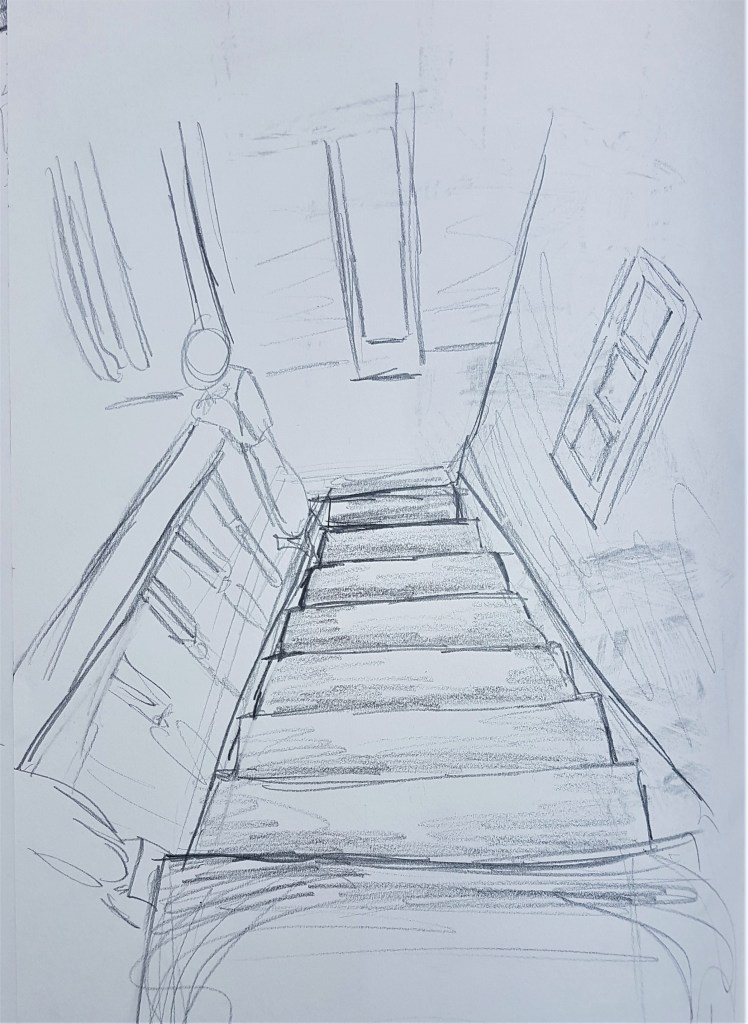
[3]
I began my studies and preliminary sketches at the top of the stairs, and slowly worked my way down the twists and turns. I kept my observational sketches fluid in order to show the movement and energy of moving up and down the stairs. I found sketches [1] and [2] difficult to capture due to the awkward placing of the bannisters. I think it works well showing the loose shape and composition, I think its interesting to look at.
I decided to try and capture the stairs as a whole before looking at what to really capture within a more detailed drawing.
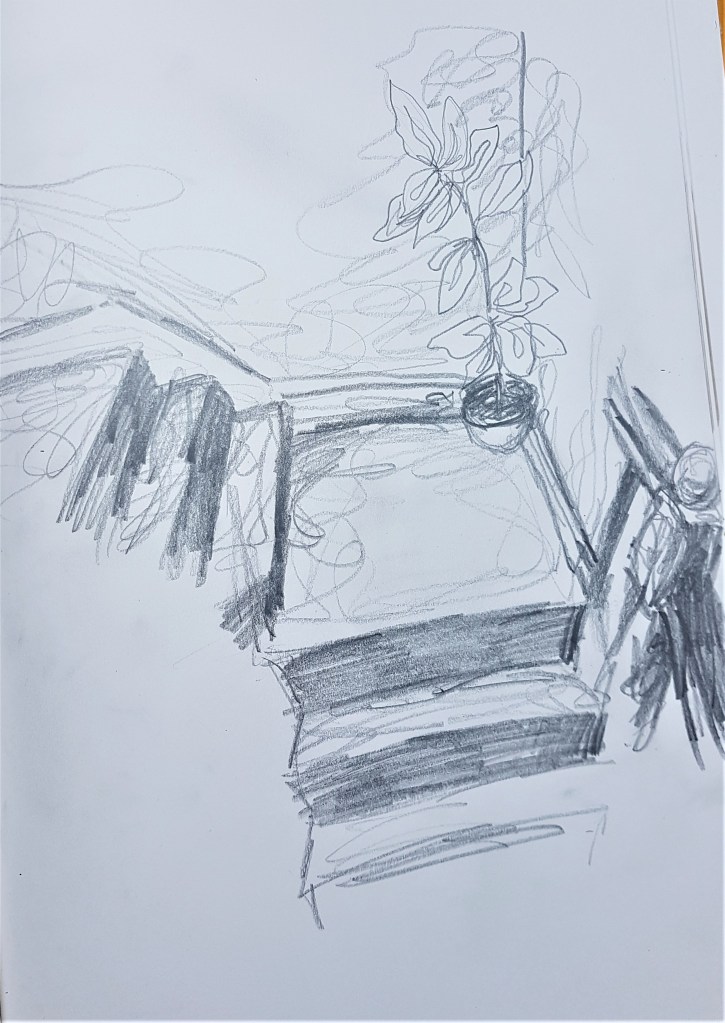
[1] 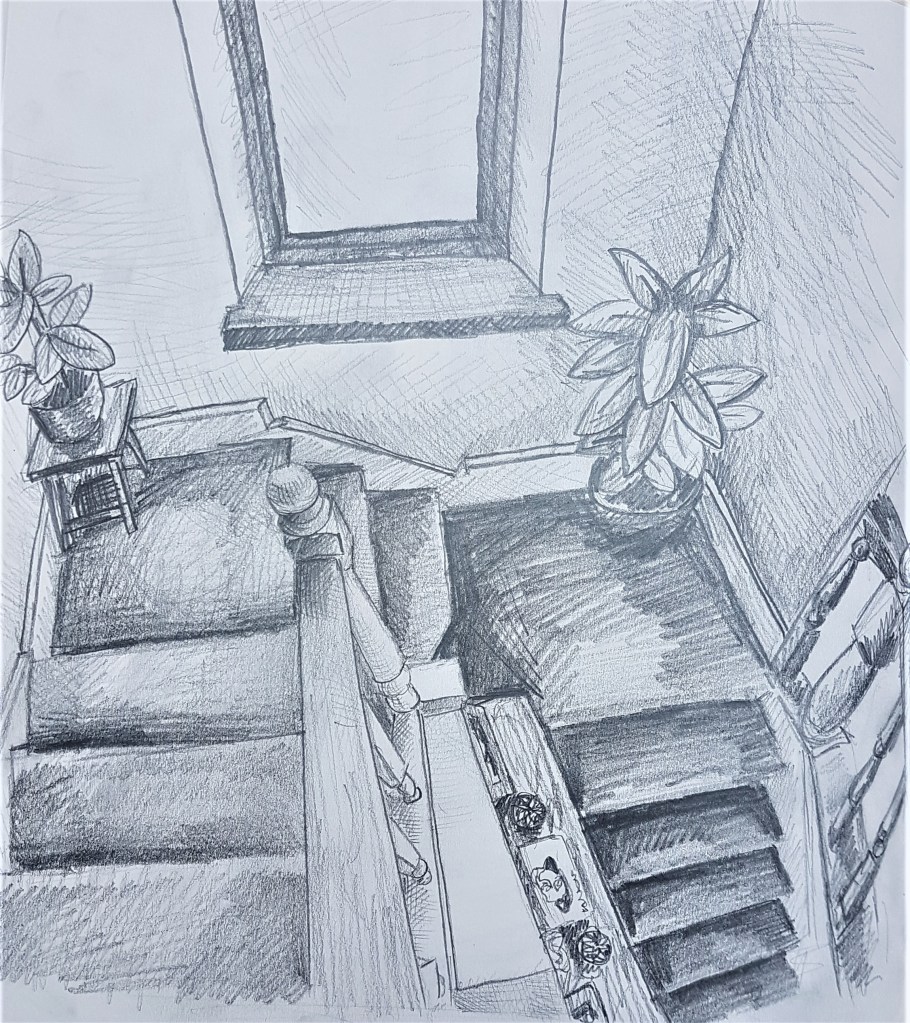
[2]
For sketch [1], I looked at trying to include the whole scene of the stairs, I think where I went wrong was my perception and point of view, I think it was too low down to include everything I wanted to. I also skewered my perception a bit too much to where I couldn’t fit the bannister in right, so I ended up leaving that area blank. I feel this kind of works in the sense of creating a much more open space, rather than a complex one. However I learned from my mistake and altered my viewpoint for sketch [2] and chose a higher point of view. This worked better for fitting in the stairs as a whole and creating a satisfying scene. I then blocked in tone and a bit of texture for the bookshelf, I really love how the bannister and bookshelf came out, they add a bit of character and complexity to an otherwise simple scene. I found preliminary sketches to be quite useful for figuring out and planning a composition, as I feel ready to tackle exercise 3. These exercises were useful in getting me to think about the shapes of a larger scene rather than the intricacies. As planning a larger scale drawing, as these exercises have been leading up to, is about the shapes and the composition, and learning to take time to focus on that has helped me think through what I’m producing more.
Moving forward I think I’m ready to begin adding colour and texture to my chosen composition.
 Simona Hopewell : Drawing 1