Still life is a way for artists to experiment and explore their technical drawing skills of capturing a texture, composition or perhaps even a narrative. Still Life can show us an ordinary object and give it new life, meaning and context with carefully thought out compositions, choice of media and execution. As said by Thaneeya on her website; ‘The magic of still life paintings is that they can show us a new way of looking at the ordinary objects around us. Once they are placed into a specific arrangement and then captured in paint, ink, pastel, or any other medium – the objects take on a whole new meaning. They are imbued with a life beyond the ordinary. Their existence becomes recorded in time.’ (Art (2014). Art is Fun. [online] Art is Fun. Available at: https://www.art-is-fun.com/still-life-paintings [Accessed 25 Oct. 2019].) . Upon initial inspection of a still life one may assume that there isn’t really a narrative, the piece is simply an observational sketch to show the artists skill. Although this can be the case, there is often a lot of narrative and themes within the context of the piece when you look closer. Why did the artist choose to focus on such objects?
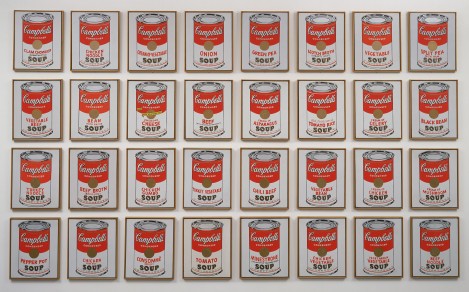
If we look to Andy Warhol’s Campbell soup cans, which were discussed in Thaneeya’s web post, Warhol actually chose to focus on that subject matter because he simply just really loved Campbells soup. As quoted on Masterworks website; ‘his friends suggested he paint the things he loved the most. The result was the iconic Campbell’s Soup Cans, 1962. Warhol said of Campbell’s Soup “I used to drink it. I used to have the same lunch every day, for 20 years, I guess, the same thing over and over again.” ‘ (Masterworksfineart.com. (2018). Andy Warhol Campbell’s Soup, 1968. [online] Available at: https://www.masterworksfineart.com/artists/andy-warhol/campbells-soup.) So here we have this added context of the subject being personal to the artist. This can then be added to the theme of mass production that had clearly sparked his interest and played a role in his production of the 32 Campbell cans. Using projections and working as ‘summarized by Warhol’s famous words: “I want to be a machine.” (Masterworksfineart.com. (2018). Andy Warhol Campbell’s Soup, 1968. [online] Available at: https://www.masterworksfineart.com/artists/andy-warhol/campbells-soup.) Combining this way of work with a personal touch by hand painting all 32 paintings. Creating a personal link between the subject matter and to him as an artist, as well as creating juxtaposition by addressing an impersonal theme such as mass production. Furthermore, with this still life he took the context of something ordinary and made it extraordinary, taking it out of a supermarket and placing it within the art world, under a spotlight. Forever changing its context.
The History of Still Life
But to fully understand the genre of Still Life, and what Still Life could mean and all of the genre’s potential, you must look to its roots. We can see Still Life being used as far back as the Egyptian Period, where the genre was used in funerary paintings, often including; ‘food—including crops, fish, and meat’ (My Modern Met. (2018). How Artists Have Kept Still Life Painting Alive Over Thousands of Years. [online] Available at: https://mymodernmet.com/what-is-still-life-painting-definition/.) We could interpret the painting to have cultural significance with what we know about the Egyptian way of life. The paintings could have been a form of offering to the Gods for the deceased to have a better afterlife. We could also interpret these paintings to show off the deceased’s wealth, the imagery depicting the ways of the deceased’s success in farming, or being able to afford fine foods. This can be linked to how paintings commissioned in later centuries were often done to show the wealth of the buyer or sitter. Or we could simply interpret the Egyptian funerary paintings significance as a personal one, as perhaps the imagery was linked to objects or foods personal to them in order to celebrate their life.
If we look forwards towards the Medieval Period (15th Century) we can see a huge shift to Still Life holding a much more religious value by both the artists and the viewers. As told by Kelly Richman-Abdou on the website My Modern Met; ‘During the Middle Ages, artists adapted the still life for religious purposes. In addition to incorporating symbolic arrangements into depictions of Biblical scenes, they also used them to decorate illuminated manuscripts.’ (My Modern Met. (2018). How Artists Have Kept Still Life Painting Alive Over Thousands of Years. [online] Available at: https://mymodernmet.com/what-is-still-life-painting-definition/). Items relating to Christ and Christian values which also held huge symbolic value were often used, items such as ; ‘coins, seashells, and bushels of fruit can be found in the borders of these books’(My Modern Met. (2018). How Artists Have Kept Still Life Painting Alive Over Thousands of Years. [online] Available at: https://mymodernmet.com/what-is-still-life-painting-definition/).
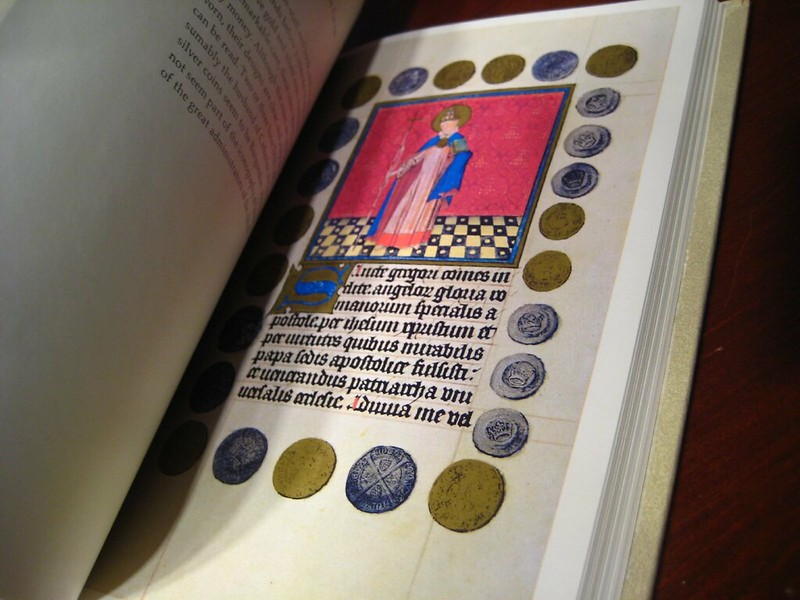
Detailed imagery and Still Life fill this book; ‘The Hours of Catherine of Cleves’ from the 15th Century.
The symbolism of coins can relate to how wealth can be found through Christianity, as gold is often linked to divinity, holiness and the preciousness of the Holy Trinity. Furthermore if we look to the Bible for what Gold means, we can definitively see how gold is seen as a precious and holy material as;
‘The Bible says God created the world and the elements within it. Gold is depicted as an asset of value.‘ (Bauman, J. (2017). What Does the Bible Say About Gold and Silver? – Peter Schiff’s Gold News. [online] SchiffGold.com. Available at: https://schiffgold.com/commentaries/bible-say-gold-silver/ [Accessed 5 Feb. 2020].)
“The silver is mine, and the gold is mine, saith the Lord of hosts.”
Haggai 2:8
So here we can see that the Gold belongs to the Lord, which could mean any depiction of gold used is a way of honouring Him and the material He has made. ‘Gold and silver are products of God – they are not a creation of man. God designed them to be intrinsically valuable and beautiful, for gold does not tarnish nor corrode.’ God created the world and the elements within it. Gold is depicted as an asset of value.‘ (Bauman, J. (2017). What Does the Bible Say About Gold and Silver? – Peter Schiff’s Gold News. [online] SchiffGold.com. Available at: https://schiffgold.com/commentaries/bible-say-gold-silver/ [Accessed 5 Feb. 2020].) Here if we look into the qualities of Gold as a material we can see that it ‘does not tarnish nor corrode’ which can represent a sense of long lasting purity, which holds a lot of value for Christians, as they seek to be pure to show their devotion for God.
If we look to the symbolism of the use of shells, we can relate it to fertility and its use in baptism as ‘Fertility is also associated with the scallop shell, as exemplified in ancient and renaissance paintings of Venus, the Roman goddess of fertility and love.’ (Christa’s South Seashells. (2018). Shells as Religious Symbols and the Meaning of Life – Christa’s South Seashells. [online] Available at: http://csseashell.com/shells-as-religious-symbols-and-the-meaning-of-life/) . Cowrie shells are often linked to fertility due to their resemblance of the vagina, and in some cultures are worn to encourage fertility.
So when assessing a piece of work or creating your own Still Life objects can hold cultural symbolism or personal symbolism which I should keep in mind going forward with my work, especially as I try to develop assessment pieces. This can help me to form a strong narrative within my work and to also construct themes that I feel are relevant.
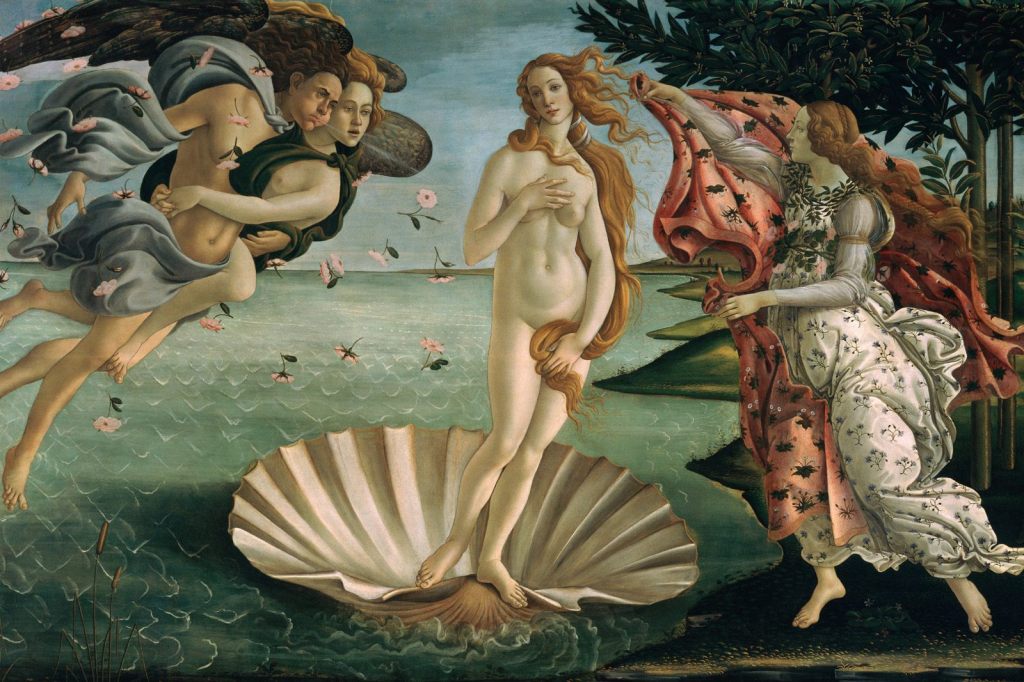
The scallop shell is used here to represent the fertility of Venus, a valuable trait in women in this period. 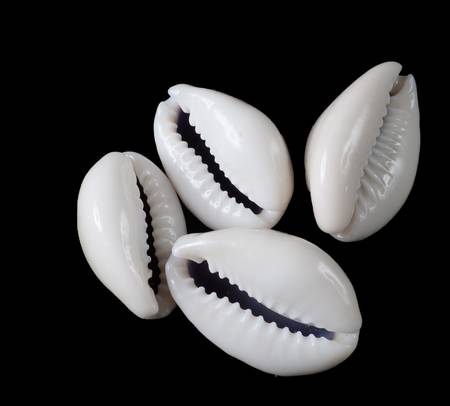
The shape of the Cowrie shell resembles the vulva/ vagina, linking it to the fertility of women in symbolism.
Milicenta (n.d.). Cowrie shells on black background. Available at: https://www.123rf.com/photo_100146119_cowrie-shells-on-black-background.html [Accessed 6 Feb. 2020].
Moving forwards looking more at traditional Renaissance approaches, the symbolic choices within the composition remained, still heavily influenced by religion, however the focus began to shift towards accuracy and skillman ship. Just how real could they portray their Still Life? The genre of Still Life was heavily influenced by Dutch Artists at the time. A popular composition within Renaissance Still Life were floral arrangements. The Dutch Golden Age artists took this concept and ‘took this interest in detailed floral art a step further with their vanitas paintings. Vanitas paintings are inspired by memento mori, a genre of painting whose Latin name translates to “remember that you have to die.” Like memento mori depictions, these pieces often pair cut flowers with objects like human skulls, waning candles, and overturned hourglasses to comment on the fleeting nature of life.’ (My Modern Met. (2018). How Artists Have Kept Still Life Painting Alive Over Thousands of Years. [online] Available at: https://mymodernmet.com/what-is-still-life-painting-definition/.) . Thus due to the popular theme of death and what it means, skulls became a popular focus for Still Life Artists. Vanitas differ from Memento Mori Still Life’s as they have more of a focus on the pleasures of the world around us and the arrogance that comes with those, by incorporating wine and musical instruments to flesh out this point of view.

Artist not available
This Flemish Vanitas is brimming with symbolism. The artist incorporated the skull for the classic imagery and symbolic gesture of Vanitas Still Life, to remind the viewer that they too will join the skull one day in their future in death. Although initially melancholy, the skull can be interpreted in a more positive tone, to grab life and live it well, as life is fleeting. This idea is further fleshed out by the symbolism of the candle nearing the end of its use, which emphasises the point of time running out. A similar point is also made by the hourglass with the writing above it reading; “Time runs fast, all youthful grace vanished before one is aware of it.” (LAWRENCE STEIGRAD FINE ARTS. (2014). LAWRENCE STEIGRAD FINE ARTS. [online] Available at: http://www.steigrad.com/flemish-school-a-vanitas-still-life.) The flower is also imagery for the passing of time (with its falling petals) which inevitably leads to death with the writing above it being quoted as; “As the beauty of the flower does not last long, a person also quickly fades.”(LAWRENCE STEIGRAD FINE ARTS. (2014). LAWRENCE STEIGRAD FINE ARTS. [online] Available at: http://www.steigrad.com/flemish-school-a-vanitas-still-life.) . The colour palette and dark tonal qualities help to create an atmosphere completely immersed within the themes of death and time. When studying Still Life and creating my own work, I should keep in mind the theme or atmosphere I want to create, and carefully construct my composition and my choice of objects(And how they link to one another) around those ideas in order to create an immersive experience for the viewer and clear focus within my work.
We can see the return of Still Life in Modern Art, with Artists such as Cezanne exploring the Still Life genre with his series of famous Still Life’s incorporating household objects and in animate objects such as fruit on table tops in his radical style that helped develop a new groundwork leading Artistic change from the 19th century to the 20th.

The accuracy in portraying the scene that was developed from the Renaissance period is still there, but adapted to a more Modern approach and take on the Still Life genre, using a looser approach to detail and strokes, creating a fluid piece that feels alive and breathing as you look at it. The bold use of colour and outlines were very new at the time and define the 19th and early 20th century Still Life period. With the thick layers of colour and tone you feel a sense of the environment, and in a way how the light is moving and dancing around the room. Attention is still applied to the different variety of textures found in the scene such as the porcelain cup and the apples ( How they reflect and respond to the light) and how they contrast to the duller textures such as the table cloth and wooden furniture. Circling back to my introduction, I get a sense that this piece is more a study of his style or a personal scene to him rather than trying to push symbolism or a theme. It’s narrative in terms of the composition of the scene is quite simple, its a sample of life and exploration of style when it comes to his technique and execution. However we can see his exploration of themes in some of his other pieces.
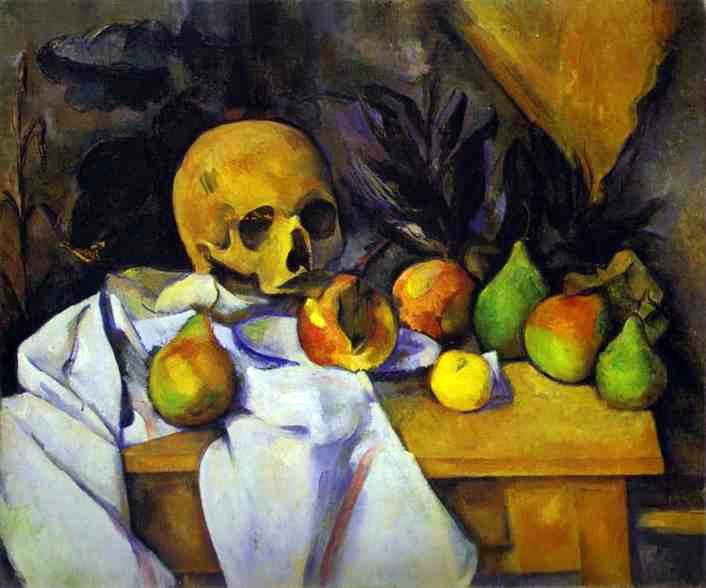
For example in his interpretation of a Vanitas Still Life, he has updated the look to his fluid style and technique, and created a juxtaposition of life and death by incorporating ripe fruit. In some ways changing the context of Vanitas Still Life and what it should traditionally look like and be. Modernising a traditional style and theme, especially with his incorporation of brighter, more vibrant colours which traditional Vanitas wouldn’t use. Although the dark tone is still put to use in his cold background, creating a dark atmosphere still, but also creating an interesting contrast in his composition with the foreground. We can see a clear shift in the colour palettes used by the 16th century to the 19th-20th century Modern Artists, and similar experimentation also occurs within Picasso’s work. We can also see the incorporation of a brighter colour palette in the piece by Andy Warhol I discussed earlier. It is clear that the 20th century opened up to more exploration with Still Life, technique and style.
However within the 21st Century, Still Life as a genre has been split into many varieties of style. Firstly I shall look at an incredibly experimentive attempt at Still Life by Tracy Emin.
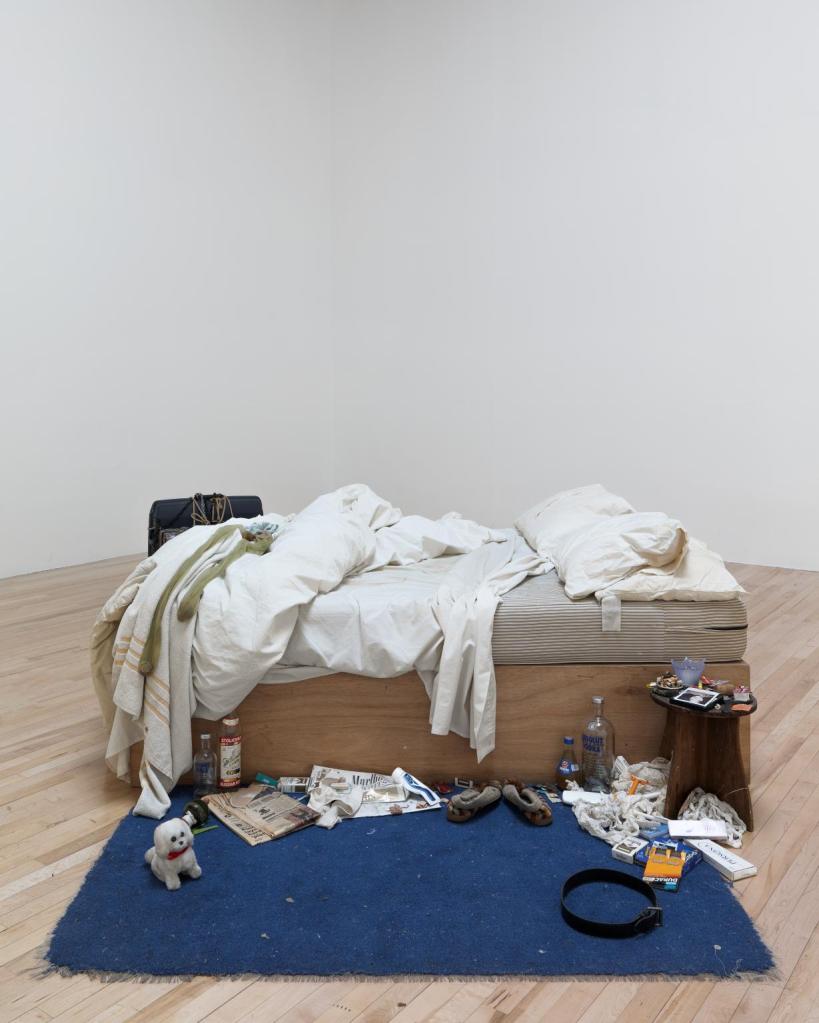
Here we see a direct and blunt attempt at Still Life, as it is literally a scene, no drawing or painting, a literal slice of Emin’s life. Here we get a glimpse into the narrative of her life and how she lives, looking at the mess surrounding the bed including empty alcohol bottles, one can assume its not healthy nor happy. The desired effect is for the piece to look messy and not have much thought put in, the composition is very effective in showing a messy dysfunctional scene. The ideas and themes (themes of substance abuse and mental illness) fit into a personal experience, the viewer is made to feel uncomfortable seeing something so personal and private as a bedroom, especially one left in such a brutally honest way. Emin really pushes the boundaries of what art and Still Life can be and the piece has even been debated over whether it can really be considered an art piece. I think its an interesting and unique approach, but not one I would like to consider for myself as an Artist, in terms of how I’d like to experiment with my skills and ideas.
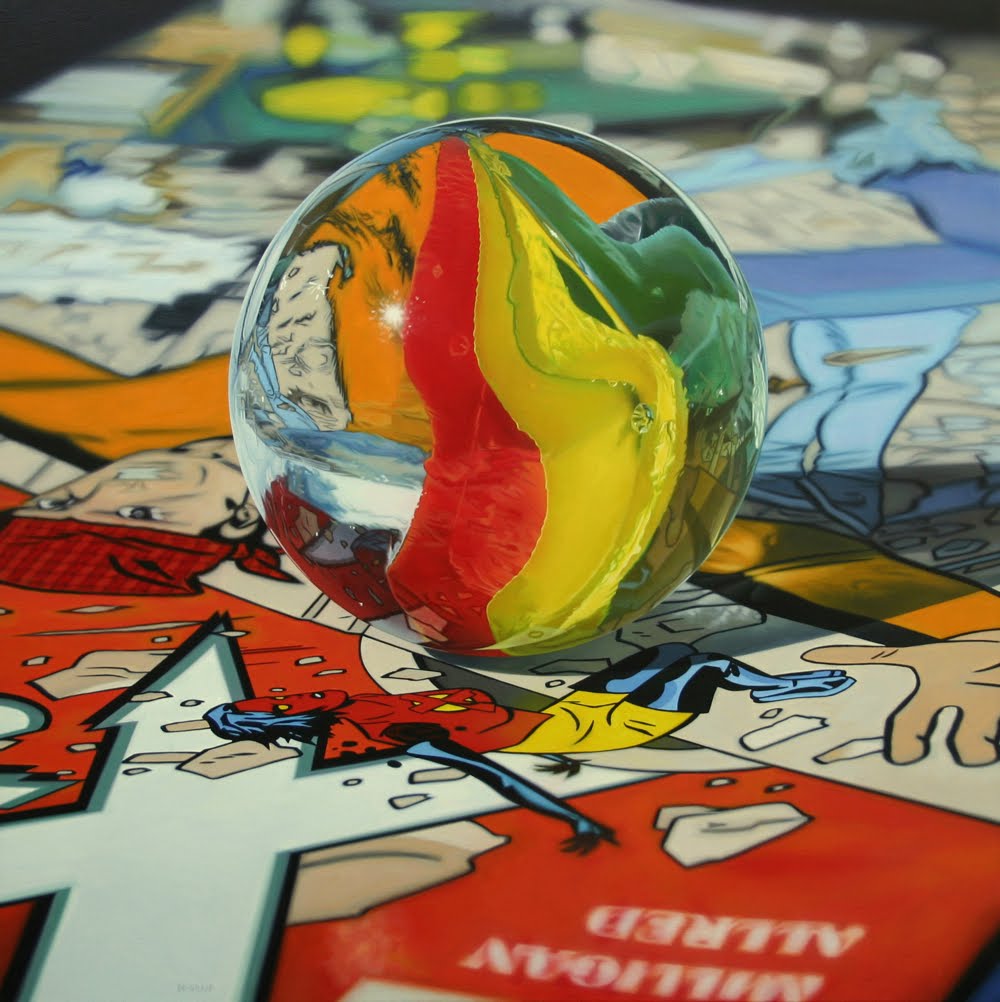
Another very common contemporary approach to the Still Life genre is hyper realism. Taking a mundane modern object and giving it extreme detail, and similar to what Warhol did, taking the ordinary and making it extraordinary. As summed up by Kelly Richman-Abdou; ‘Much like the pieces that inspire them, these high-definition paintings prove that even the most mundane objects can be made into masterpieces.’ (My Modern Met. (2018). How Artists Have Kept Still Life Painting Alive Over Thousands of Years. [online] Available at: https://mymodernmet.com/what-is-still-life-painting-definition/.) Upon first inspection these paintings are often assumed to be photographs, but offer a new depth to the reality they capture, as Katie Hosmer sums this up as; ‘The artist focuses on every extreme detail to create realistic depth in layers of crisp reflections. With a steady hand and a strong vision, he produces a new reality based on his own imagination.’ (My Modern Met. (2013). Hyperrealistic Still Life Paintings Filled with Layers of Detail. [online] Available at: https://mymodernmet.com/jason-de-graaf-hyperrealistic-still-life-paintings/ [Accessed 6 Feb. 2020].) I would love to experiment and play around with realism in my drawings and work, however I don’t think I could reach the level of hyper realism that some artists can. But I’d love to develop my skills and see how far I can push my drawings into hyper realism, and with that create a new sense of reality within my work.
Evidently, when it comes to my work and thinking about what I’d like to create in terms of Still Life for my course, I have a lot to consider. Looking back to Thaneeya’s website, developing Still Life includes a vast amount of symbolism, themes that must be thought about carefully for my composition, as; ‘The objects chosen for a still life painting often have a special meaning, either on a personal, cultural, societal, religious or philosophical level. The themes surrounding the artwork often provoke introspection and reflection in the viewer. The way that the objects are depicted can evoke a wide variety of emotions, depending on their arrangement, as well as the lighting, color choice, and handling of the paint. These are all things to take into account when viewing a still life artwork. They are especially important to consider when you are creating one.’ (Art (2014). Art is Fun. [online] Art is Fun. Available at: https://www.art-is-fun.com/still-life-paintings.) . I have to look for deeper meaning in what I want to purvey within my work, how personal do I want it to be? And what kind of reflection do I want to evoke from the viewer? From observing Modern Artists like Cezanne and Picasso, it is clear need to think about my use of colour, technique and medium, as they can have a significant effect on the feeling/ emotions of my work and could potentially add new context to any theme or narrative I am developing within my work. I am excited to start immersing my self in Still Life and exploring my ideas to see what I can create.
 Simona Hopewell : Drawing 1
