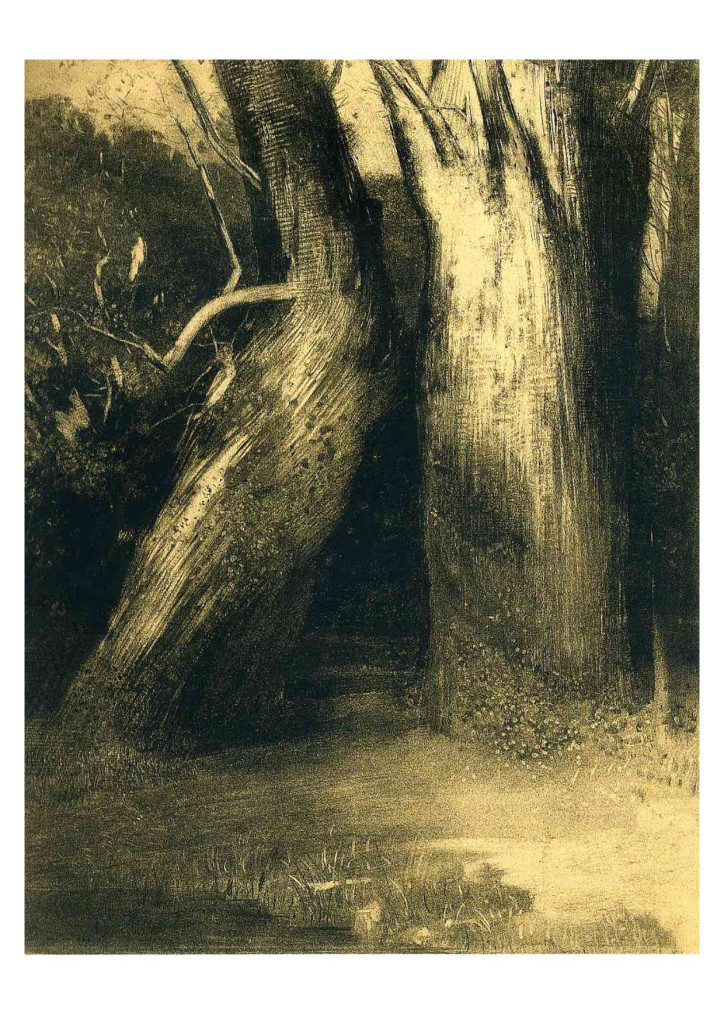
Odilon Redon is an important artist when looking at tone. In this first piece; ‘Two Trees’ my eyes are instantly drawn to the centre due to the contrast created by the dark shadows behind the trees and where the light hits the trees. This focal point being in the centre is also helped by the lines of the two trees connecting/ meeting in the centre of the drawing. Furthermore the composition helps to give an eerie feeling to his work. For example the way the trees are bare but also seem twisted and crooked. But also his technique in his drawing adds to his gothic style, the cross hatching and use of line with the dark tonal background work well to create something dark and mysterious. As stated in an online blog ‘Odilon Redon was greatly inspired by the author/poet Edgar Allen Poe’ [“Pencil-Case.” (2016). Odilon Redon – “Pencil-Case.” [online] Available at: https://lucyannwaterhouse.co.uk/category/odilon-redon/ [Accessed 6 Jan. 2020]
This influence can be clearly seen in his other works, which have a more surreal quality to them.
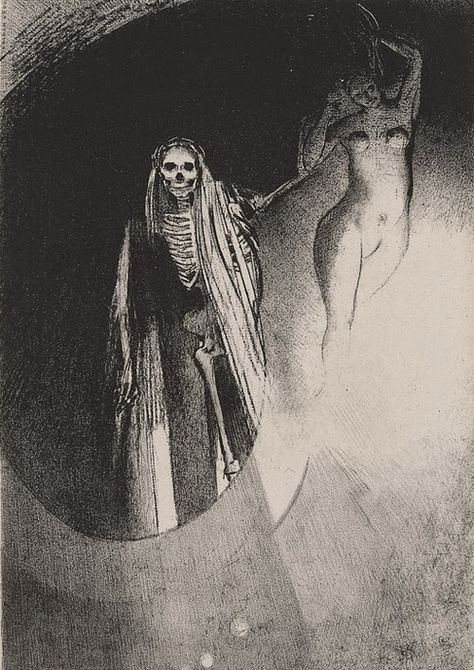
In this piece, an etching in a series based on the Temptation of Saint Anthony, the influence of Edgar Allan Poe is still relevant in his interest in exploring death as a figure. His tonal detail in these etchings is amazing. His use of line, and having the lines moving in the directions of light/shadow from the figure of death helps create direction, rather than by showing light with shading or cross hatching. It draws your eye to the figures, but more so the figure of death, making them it a clear focal point. There is a strong narrative in his work, enforced by his use of tone. The woman, surrounded by light, being pulled into darkness by death, knowing she will fade. I love the details in how he shaded the nude woman, the stipples and light cross hatching, highlighting the curves of her body. The narrative of the piece could also be seen as representing a cycle in a sense, with the use of a circular hole which the figure of death peers out of, but furthermore how the abdomen of the woman is where the source of light is coming from. As women are a source of life, biologically, the light may be reflecting this idea of life. The piece could be commenting on who greets you as you come in and leave life.
Redon’s markings are subtle and beautiful and tie the piece together, creating a dark atmosphere, brimming with meaning.
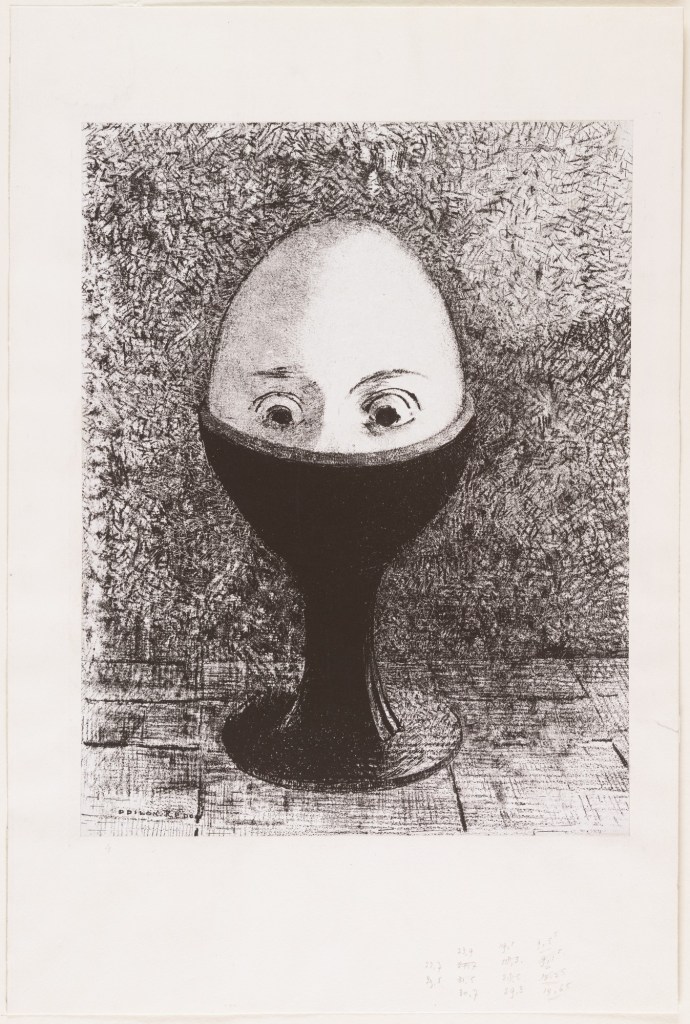
In this piece titled ‘The Egg’, Redon uses his tonal markings to create a creepy and surreal atmosphere. He often created characters, influenced by his knowledge of literature and writings and ideas during his period of time [1885]. As said best in a write up on this piece on the MoMA site ;’Redon populated his work with a cast of hybrid characters such as this one. These inventions reflected the artist’s knowledge of Darwin’s theory of evolution, his visits to the natural history museum, lectures he attended at a medical college, and his own dreams and fantasies.’ [Odilon Redon (2020). The Egg (L’Œuf). [online] The Museum of Modern Art. Available at: https://www.moma.org/collection/works/61960 [Accessed 7 Jan. 2020]. The surrealist quality and markings create an element of confusion between the work and the viewer. The random and irregular markings in the background help enforce a sense of shock and surrealism, with a weird, creepy atmosphere. I love the use of lines towards the bottom of the piece which create the texture of a wooden table/floor/material effectively. From the way he created lines varying in size, and his use of cross hatching you get a sense of the wood being on the rougher side in terms of texture, which helps add to an almost unwelcoming feeling, almost as if you’re intruding on this egg. This is also enforced from the eggs startled and shocked expression. I like how he varied his technique in his markings when creating shadows, which is needed when creating such a dark, tonal piece. For example his use of stippling and making small, subtle markings for shading the white egg. It helps keep the contrast between the egg and the background, had he used harsher strokes or markings on the egg, it would have made for a complicated piece tonally, as it would have blended the foreground and background together. Looking at the markings used and the picture as a whole, I would describe it in one word as: confusing. Its not meant to make sense, and to me, this is strengthened by his markings in the background not making sense. His markings hold weight and meaning, from the way he applied them, which links back to on of my first exercises, where I used emotion to control how my markings came out. To see this in practice from another artist just shows how important your markings are and how you can do so much more with them in evoking emotions.
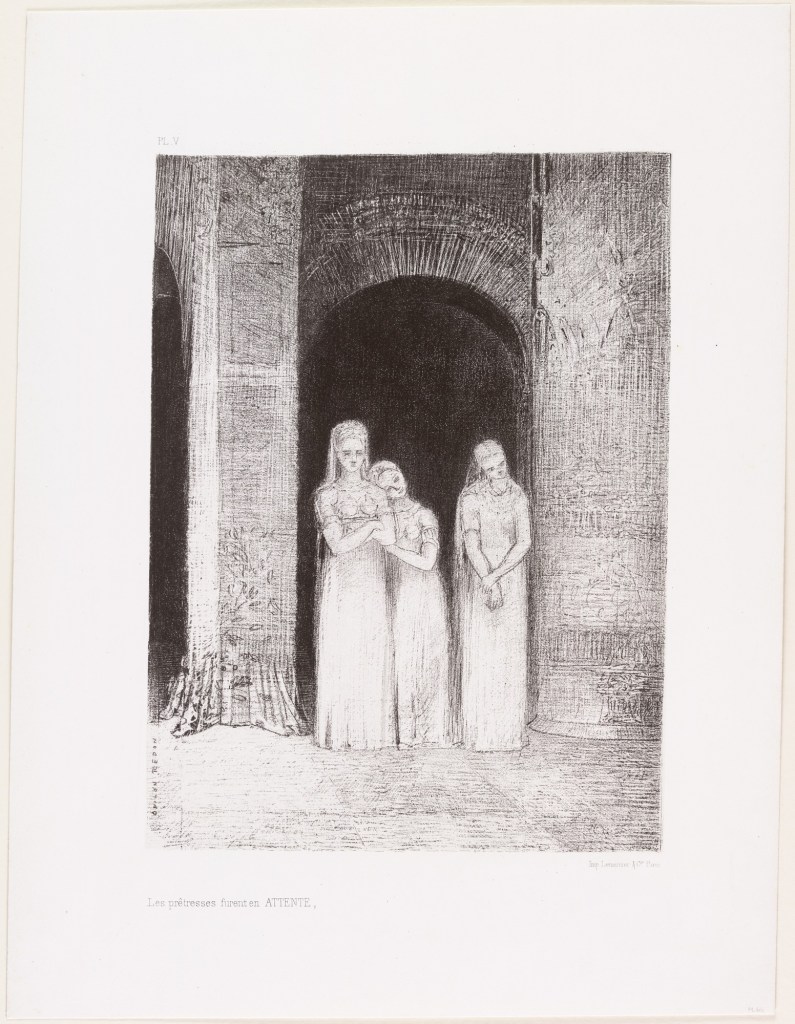
This piece is a lot lighter than the previous drawings/etchings I have looked at. It has an airiness to it. I love the contrast of the priestesses compared to the dark door way behind them, it helps highlight them and symbolise the purity and morality of their position as priestesses. The texture shown is limited as the building and surroundings are made of stone. This is helped by the subtle tonal markings Redon has used; keeping his lines smooth and straight for the most part. The focus on highlights in this piece help to forge an atmospheric tone somewhat different to his previous work, his previous etchings are dark and present a gloomy and dark atmosphere. However in this piece by limiting his use of darker tones he creates a sense of bright day as the Priestesses are waiting. The dark use of tone used behind the priestesses adds a sense of dread upon closer inspection, as two of the girls look down and are not very eager of what they are waiting for. Looking at Redon’s past work and his focus on the dark and gloomy, leads me to believe that in this narrative he has created, the bright light is a false sense of security as the darkness looms behind them, perhaps foreshadowing something dark that they are awaiting.
Looking at the work of Odilon Redon has helped me to further realise the importance of my use of tone and markings in order to create an atmosphere or potentially form a narrative within my work. By choosing the directions of my lines to correspond with the direction of light and by carefully choosing the way I make my markings for texture, I can create my desired atmosphere. But furthermore how ones markings can evoke emotion helps purvey more about the atmosphere, so I should experiment even further with that, especially when it comes to capturing and creating tonal elements in my work.
 Simona Hopewell : Drawing 1